Swollen diatom
Epithemia turgida
The swollen diatom is a unicellular alga from the order Rhopalodiales. It is characterized by a strongly convex dorsal side and a nearly straight ventral side, giving it a hump-backed appearance. This species lives primarily epiphytically on aquatic plants or on stones in lime-rich, stagnant, or slow-flowing waters. A unique feature is its symbiosis with nitrogen-fixing cyanobacteria (spheroid bodies) inside its cell.
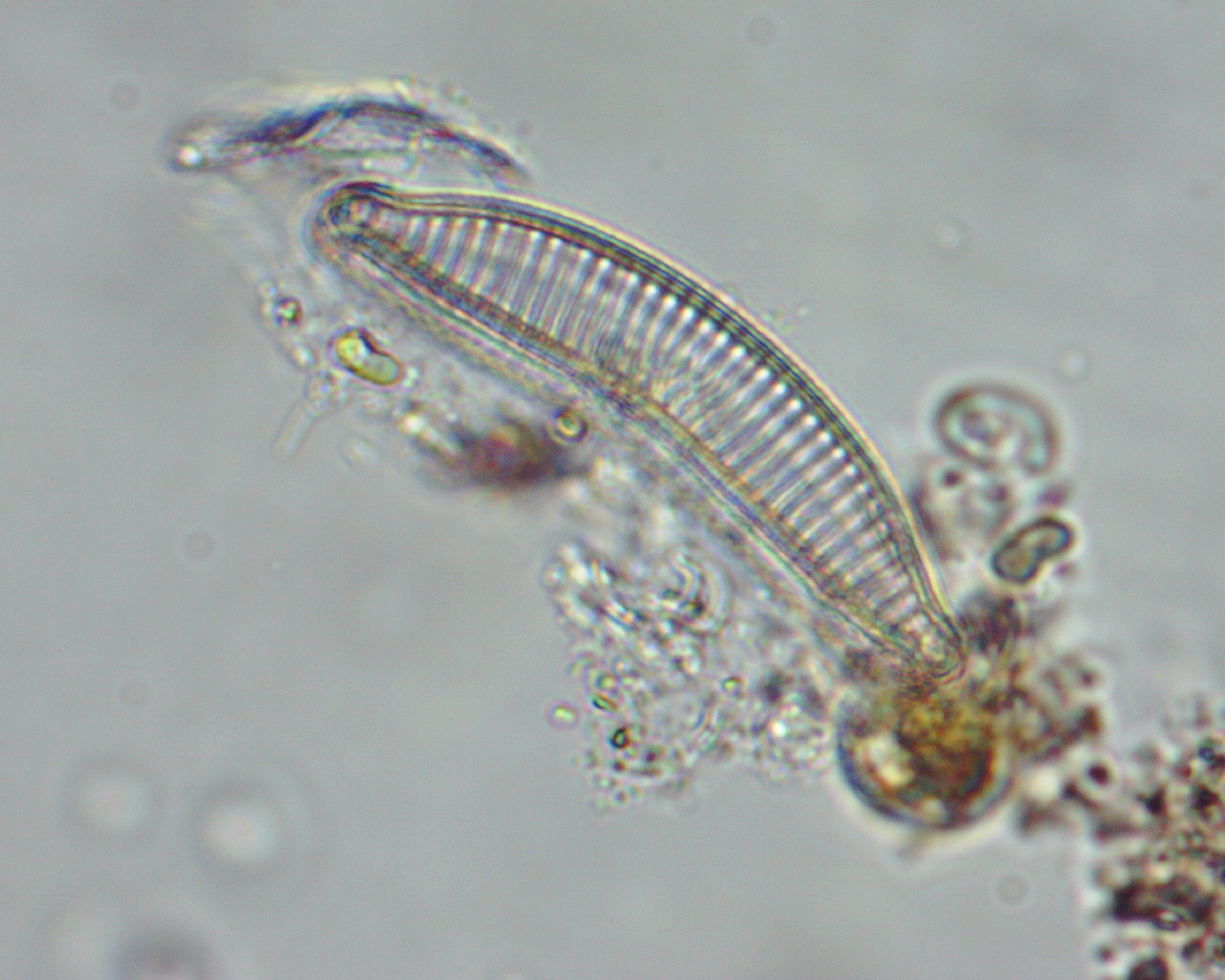
Details
Oxygen production
Produces oxygen as a byproduct of photosynthesis.
Habitat function
Part of the biofilm (periphyton), serving as a habitat and food source for microorganisms.
Nutrient uptake
Uptake of phosphates and silicates; fixation of atmospheric nitrogen by cyanobacterial symbionts.
Food source for
Invertebrate grazers and benthic filter feeders.
Human use
Used in paleolimnology to reconstruct past environmental conditions.
Ecology
Ecological role
Important primary producer and nitrogen source in aquatic ecosystems, especially in nutrient-poor but lime-rich habitats.
Natural predators
Grazers such as snails, mayfly larvae, and various small crustaceans (zooplankton).
Competitor species
Other epiphytic diatoms such as Cocconeis species or green algae.
Ecosystem service
Oxygen production and nitrogen fixation within the water body.
Threats
Excessive eutrophication (hypertrophy) and acidification of water bodies.
Scientific profile
Protection & threats
Main threats
Eutrophication (especially due to phosphate excess), loss of littoral habitats through shoreline engineering, decline of macrophyte beds, and acidification of water bodies.