Pirate wolf spider
Pirata piraticus
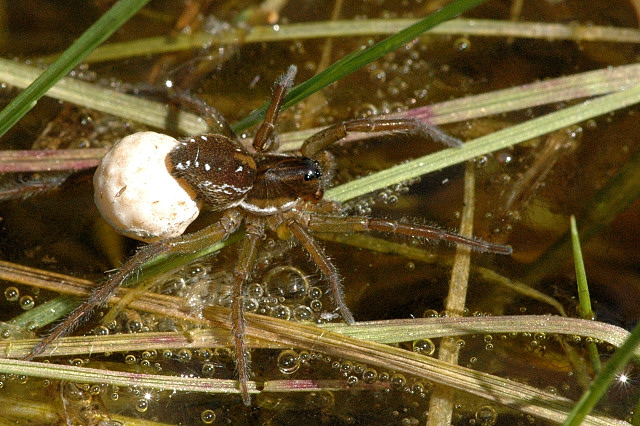
The pirate wolf spider is a medium-sized wolf spider that prefers habitats in the immediate vicinity of standing or slow-moving water bodies. It is well-known for its ability to run across the water surface using water-repellent hairs and to dive underwater when threatened. It is characterized by a light, fork-shaped pattern on the dark prosoma and two rows of white dots on the abdomen.
Details
Identification
Light to dark brown prosoma with a light tuning-fork pattern; opisthosoma with rows of whitish dots; legs usually uniform light brown or slightly annulated.
Social behavior
Solitary and territorial towards conspecifics outside the mating season.
Diet
Small insects, especially mosquito larvae, water striders, and springtails living on or near the water.
Hunting strategy
Ambush predator and active pursuer; uses water surface tension to sense prey vibrations and run across the water.
Spawning substrate
Egg sac is carried by the female attached to her spinnerets.
Overwintering
Overwinters as subadult or adult in leaf litter or moss cushions near the water.
Ecology
Ecological role
Important predator in the ecotone between land and water; regulates insect populations in riparian areas.
Natural predators
Birds, amphibians (frogs), predatory insects, and larger spider species.
Competitor species
Other wolf spiders of the genera Pirata and Pardosa as well as water striders.
Ecosystem service
Biological pest control through the consumption of mosquitoes and other insects.
Threats
Destruction of wetlands, coastal engineering/riparian reinforcement, and pesticide input into water bodies.
Scientific profile
Profile
Distinguishing features
Pirata piraticus is characterized by its ability to run on the water surface. Morphologically diagnostic is the fork-shaped mark on the prosoma extending to the posterior margin. Unlike Pirata tenuitarsis, the white hair spots on the opisthosoma are usually more distinct. The anterior lateral eyes are larger than the anterior median eyes.
Habitat
Highly hygrophilous species. Inhabits riparian zones of stagnant or slow-moving waters, bogs, marshes, and wet meadows. Frequently found on floating vegetation.
Role in food web
Important predator in riparian ecosystems; regulates populations of small insects; serves as prey for amphibians, birds, and larger spiders.
Protection & threats
Main threats
Loss of wetlands due to drainage, structural modification of shorelines, and intensive agricultural use of adjacent areas.
Population trend
Widespread and common in suitable habitats; classified as 'Least Concern' in the German Red List.