Little Grebe
Tachybaptus ruficollis
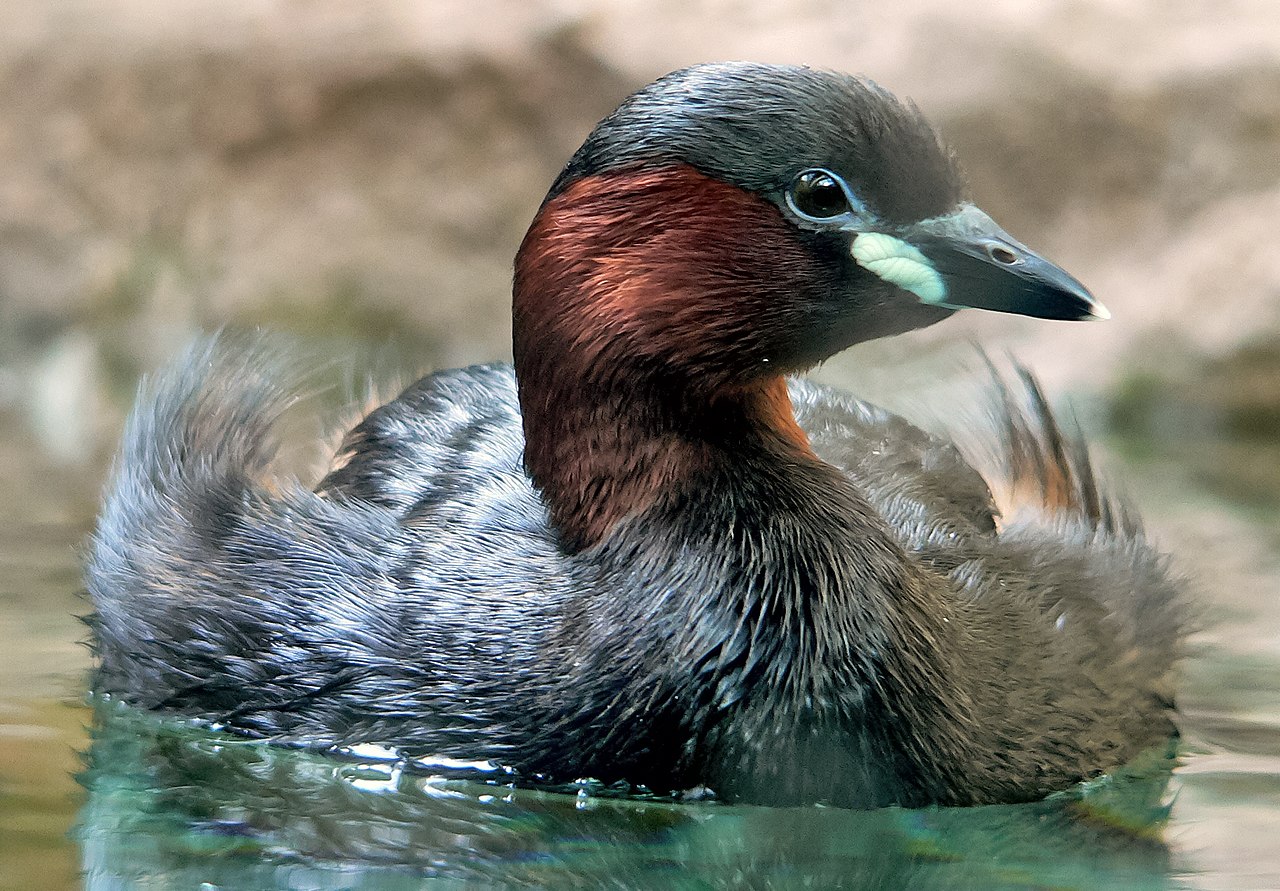
The Little Grebe is a small, stocky waterbird characterized by a distinctive pale patch at the base of its bill. In breeding plumage, it displays chestnut-colored cheeks and neck, whereas its non-breeding plumage is a more muted grey-brown. It is an excellent diver and prefers nutrient-rich, still waters with dense vegetation.
Details
Identification
Compact body, short pointed bill with a yellowish-white patch at the gape, reddish-brown neck sides in breeding plumage.
Social behavior
Highly territorial during the breeding season, often found in loose groups on ice-free waters during winter.
Diet
Insects and their larvae, small crustaceans, mollusks, and occasionally small fish and tadpoles.
Hunting strategy
Active hunting by diving; searches the bottom of the water body and aquatic plants for prey.
Overwintering
Overwinters on ice-free inland waters or in sheltered marine bays.
Ecology
Ecological role
Predator of aquatic invertebrates and small fish; serves as prey for larger birds of prey and predatory fish.
Natural predators
Pike, Marsh Harrier, Brown Rat, Fox (especially at nests).
Competitor species
Other grebes such as the Black-necked Grebe or Eurasian Coots when foraging.
Ecosystem service
Regulation of insect populations in aquatic habitats.
Threats
Habitat loss due to drainage, disturbance during the breeding season, pollution of water bodies.
Scientific profile
Morphology & ID
Breeding plumage
Dark brown to blackish-brown upperparts, chestnut-red neck sides and cheeks. Prominent yellowish-white patch at the base of the bill (gape). Underparts brownish-white.
Non-breeding plumage
Overall paler and less contrasty. Upperparts grey-brown, throat whitish, flanks light brown to buff. The yellow gape patch is absent or very pale.
Juvenile plumage
Head with characteristic black and white stripes. Body plumage brownish-grey. Bill yellowish with a dark tip.
Sexual dimorphism
Minimal; males are on average slightly larger and heavier than females, plumage is identical in both sexes.
Distinguishing features
Smallest European grebe. Dumpy shape with a conspicuously fluffy rear end ('powder-puff'). Yellow gape patch in breeding plumage. Often resembles a small floating ball.
Confusion species
Black-necked Grebe (Podiceps nigricollis) in non-breeding plumage (which has a steeper forehead and slightly upturned bill), Slavonian Grebe (Podiceps auritus).
Bill
Short, straight, and pointed. Black with a pale tip in breeding plumage; more brownish-yellow in non-breeding plumage and juveniles.
Vocalization
Song
A very loud, long-lasting, whinnying trill 'bibibibibibi', often performed as a duet by the pair and carrying far across the water.
Call
A short, metallic 'whit' or 'bi-it' used as a warning or contact call.
Distribution & migration
Breeding range
Widespread in the Palearctic (Europe to Japan), Africa, and parts of South Asia. Occurs throughout Central Europe.
Wintering range
Winters in ice-free inland waters, rivers, or sheltered coastal areas within or south of the breeding range.
Migration details
Resident in mild regions; short-distance migrant in colder areas. Moves to flowing waters or coasts when lakes freeze over.
Habitat
Breeding habitat
Small, nutrient-rich standing waters (ponds, oxbow lakes, gravel pits) with well-developed marginal vegetation and submerged plants. Also on slow-flowing ditches.
Foraging habitat
Shallow water zones with abundant invertebrates and small fish, often near structural vegetation.
Breeding biology
Nest construction
Floating nest made of decaying plant material (reeds, aquatic plants), usually anchored to marginal vegetation or overhanging branches.
Eggs
Initially pure white, but quickly stain yellowish-brown to dark brown through contact with damp nesting material.
Parental care
Both parents incubate and lead the young. The chicks are often carried on the parents' backs during the first few days.
Diet & behaviour
Diet breeding
Predominantly aquatic insects and their larvae (dragonflies, beetles, bugs), small crustaceans, mollusks, and occasionally tadpoles.
Diet winter
Increasing proportion of small fish (e.g., sticklebacks, gudgeons, small perch) alongside invertebrates.
Feeding technique
Diving (usually 10-20 seconds deep), picking from the water surface, or searching through submerged plants.
Foraging strategy
Active underwater searching; uses dense vegetation as cover and hunting grounds.
Sociality
Strictly territorial and solitary during the breeding season; more gregarious in winter, though it does not form large, stable flocks.
Flock behaviour
Loose aggregations possible at food-rich, ice-free waters in winter, but no coordinated flock movements.
Protection & threats
Main threats
Loss of small water bodies through drainage, disturbance from angling and recreational activities, eutrophication, predation by invasive species such as the American mink.
Population trend
Stable; widespread in Germany with an estimated 15,000 to 27,000 breeding pairs (ADEBAR).
Conservation measures
Protection and creation of small water bodies, preservation of reed and marginal vegetation, management of recreational activities at breeding sites.