Common Ground Beetle
Nebria brevicollis
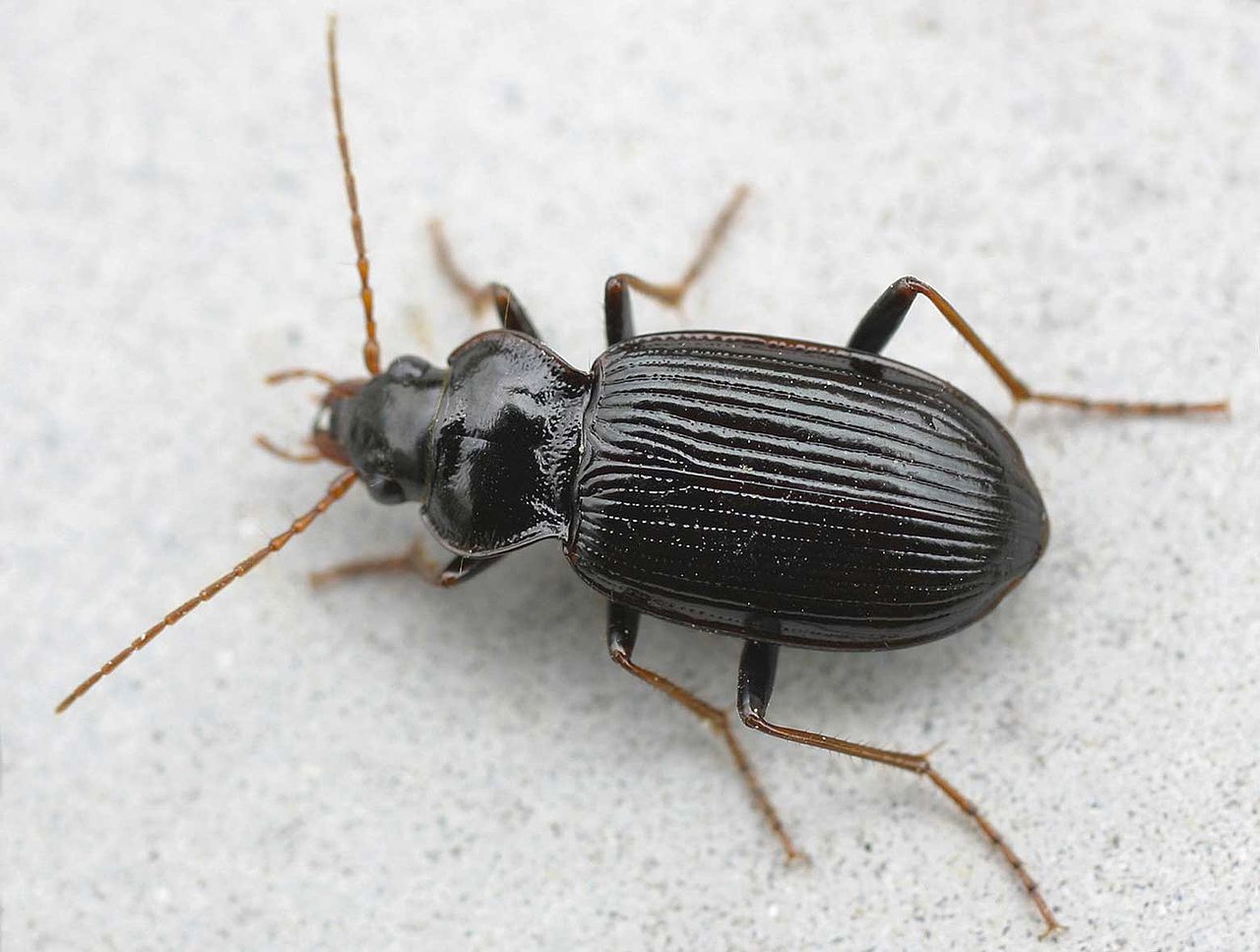
The Common Ground Beetle is a medium-sized beetle belonging to the Carabidae family. It is characterized by a shiny black body and reddish-brown antennae and legs. The species is widespread across Europe and prefers moderately moist habitats, where it acts as a swift predator within the leaf litter. It is particularly known for its speed and its primarily nocturnal lifestyle.
Details
Identification
Heart-shaped pronotum, filiform antennae, black elytra with distinct punctured striae, legs usually reddish-brown.
Social behavior
Solitary; interactions between individuals primarily occur during the mating season.
Diet
Predatory diet consisting of small invertebrates such as mites, collembolans, aphids, and small worms.
Hunting strategy
Active visual and pursuit predator that searches the ground surface at night.
Spawning substrate
Moist soil or moss layers.
Overwintering
In Central Europe, it mostly overwinters as a larva in the soil, more rarely as an adult.
Ecology
Ecological role
Important predator in the soil food web; contributes to the biological control of insect populations.
Natural predators
Insectivorous birds, small mammals like hedgehogs and shrews, and amphibians.
Competitor species
Other medium-sized ground beetle species, particularly from the genus Pterostichus.
Ecosystem service
Natural pest control in agriculture and forestry through the predation of agricultural pests.
Threats
Intensification of agriculture, high pesticide use, and increasing soil sealing.
Scientific profile
Profile
Distinguishing features
Heart-shaped pronotum with distinct punctures at the base. The elytra feature deep, punctured longitudinal striae. A key feature for distinguishing it from Nebria salina is the presence of pubescence on the dorsal surface of the hind tarsi (present in N. brevicollis).
Habitat
Eurytopic species inhabiting a wide range of habitats, including deciduous and mixed forests, gardens, hedges, parks, and agricultural land (arable fields). Prefers shaded to semi-shaded locations.
Diet
Zoophagous (predatory); feeds on a variety of small invertebrates, especially springtails (Collembola), mites, small insect larvae, and worms.
Role in food web
Important predator in the soil fauna, contributing to the regulation of small arthropod populations; serves as prey for birds, hedgehogs, and amphibians.
Protection & threats
Main threats
Intensive agriculture (pesticide use), large-scale soil sealing, and the loss of edge structures such as hedges and field margins.
Population trend
Stable; the species is one of the most common and widely distributed ground beetles in Central Europe.
Conservation measures
Promotion of extensive agriculture, preservation of hedges and forest edges, and protection of mixed deciduous forests with a natural litter layer.