Riverbank wolf spider
Arctosa cinerea
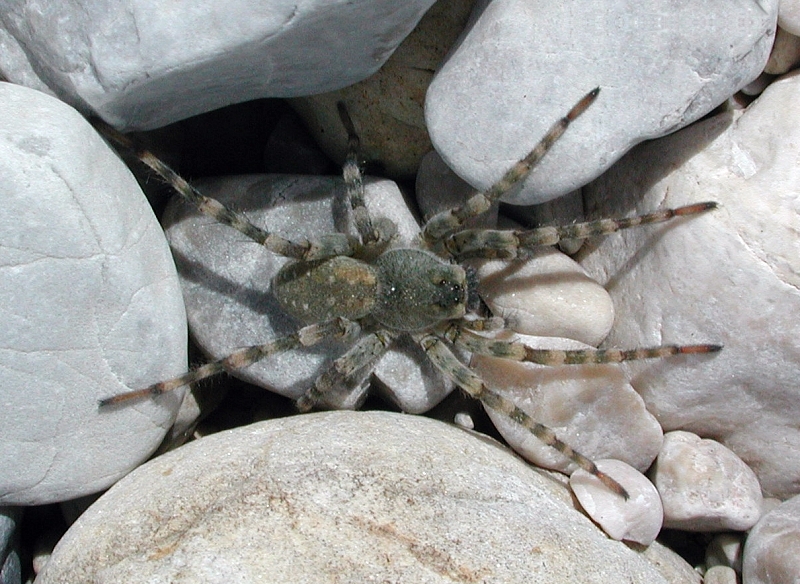
The riverbank wolf spider is a large, distinctive wolf spider with cryptic coloration perfectly adapted to sandy and gravelly riverbanks. It constructs silk-lined burrows up to 15 cm deep in the substrate to protect itself from floods and predators. This species is a specialist of dynamic river systems and is highly sensitive to river engineering and habitat stabilization. Consequently, it is considered critically endangered in many parts of Central Europe due to the loss of natural pioneer habitats.
Details
Identification
Grey-brown mottled pattern for camouflage, robust legs with spines, characteristic eye arrangement of wolf spiders (4-2-2).
Social behavior
Solitary and territorial towards conspecifics; exhibits aggressive behavior during encounters.
Diet
Predatory diet consisting of insects (such as beetles and flies) and other arachnids hunted on the ground.
Hunting strategy
Ambush and active visual hunter without a web; relies on speed and surprise when capturing prey.
Overwintering
Overwinters as subadult or adult in deep burrows in the ground above the high-water line.
Ecology
Ecological role
Important predator within the pioneer fauna of riverbanks; regulates insect populations in floodplains.
Natural predators
Birds, lizards, spider wasps (Pompilidae), and larger predatory insects.
Competitor species
Other wolf spider species of the genera Pardosa or Pirata in more humid peripheral areas.
Ecosystem service
Natural pest control through the predation of insects.
Threats
River channelization, bank stabilization, loss of natural river dynamics, gravel mining, and disturbance from recreational activities.
Scientific profile
Profile
Distinguishing features
With a body length of up to 19 mm, it is one of the largest native wolf spiders. Characteristic features include the high-contrast spotting on the prosoma and opisthosoma and its strict association with dynamic riparian habitats. Eye arrangement is typical for Lycosidae (4-2-2).
Habitat
Highly specialized pioneer species of dynamic river landscapes. Inhabits sparsely vegetated gravel, sand, and shingle banks of wild rivers as well as primary coastal dunes.
Role in food web
Significant predator in the pioneer vegetation of riverbanks; serves as prey for specialized birds and spider wasps.
Protection & threats
Main threats
Loss of dynamic river sections due to channelization, embankment, and dams. Gravel mining, recreational over-use (trampling), and the absence of natural flooding events.
Population trend
Strongly declining throughout Central Europe due to large-scale destruction of natural wild river landscapes; classified as 'Endangered' (Red List 2) in Germany.