Black Medic
Medicago lupulina
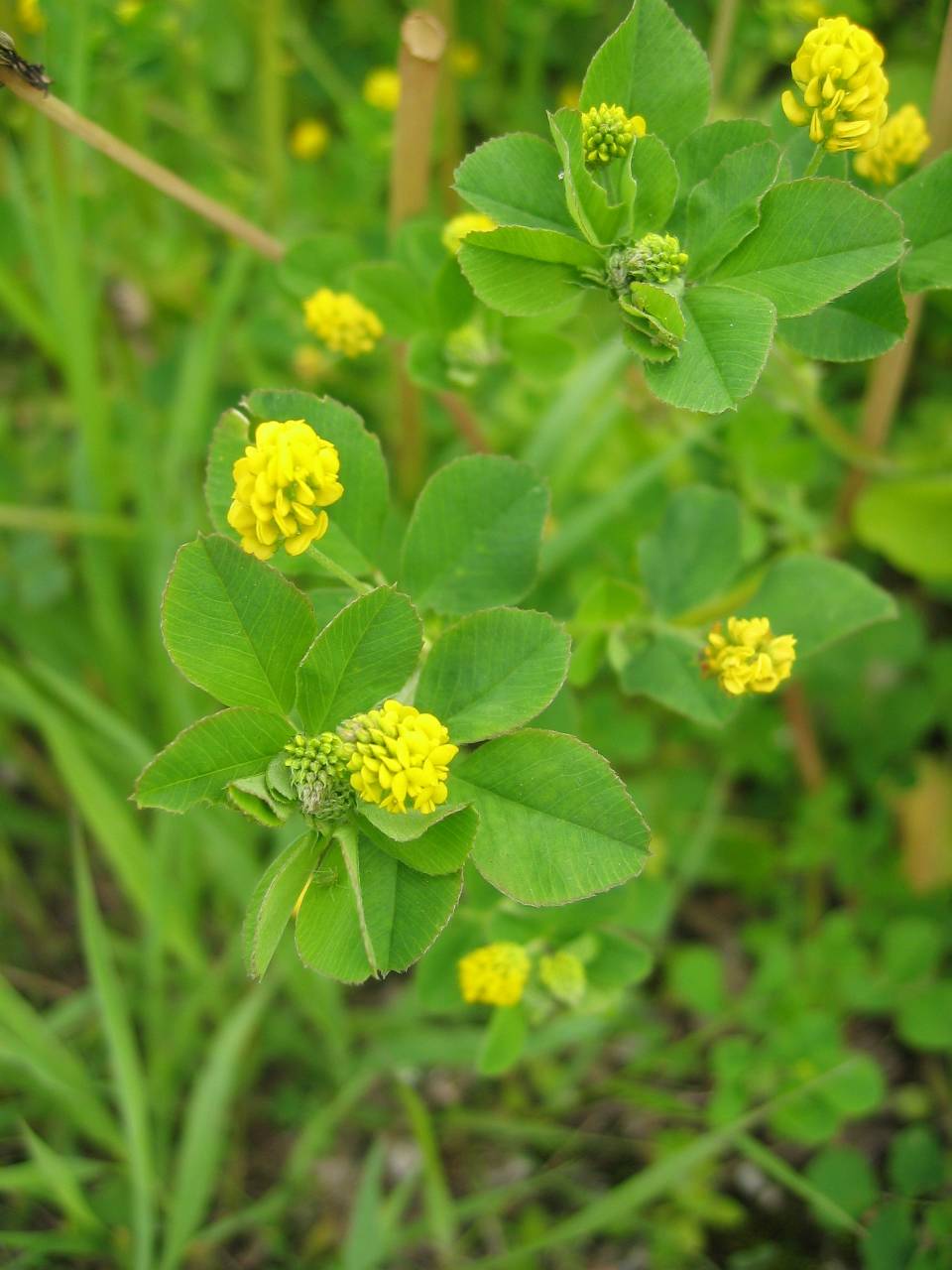
Black medic is an annual or short-lived perennial legume in the pea family, typically reaching heights of 10 to 50 cm. It is characterized by its trifoliate leaves and small, globular yellow flower heads that resemble those of true clovers. After flowering, it produces distinctive kidney-shaped seed pods that turn black when ripe, giving the plant its common name. It acts as a pioneer species, thriving in calcareous, dry habitats such as meadows, roadsides, and disturbed ground.
Details
Habitat function
Important forage plant for wild bees and butterfly larvae; soil stabilizer on raw soils.
Nutrient uptake
Primarily acquires nitrogen through atmospheric nitrogen fixation in root nodules.
Food source for
Wild bees (e.g., Osmia species), honeybees, caterpillars of the Common Blue butterfly.
Human use
Occasionally used as forage for small livestock or as green manure in agriculture.
Ecology
Ecological role
Nitrogen fixer through symbiosis with rhizobia (root nodule bacteria); improves soil quality.
Natural predators
Grazing animals, various insect larvae (weevils), snails.
Competitor species
More competitive grasses and herbs under high nitrogen fertilization.
Ecosystem service
Soil improvement, erosion control, provision of nectar and pollen for insects.
Threats
Intensive management, over-fertilization of nutrient-poor sites, sealing of roadsides.
Scientific profile
Profile
Reproduction
Generative via seeds; the species forms a long-lived soil seed bank, which facilitates recolonization after disturbances.
Protection & threats
Main threats
Intensification of grassland use (heavy fertilization), conversion of grassland to arable land, and abandonment of land use (scrub encroachment/succession) on marginal sites.