Spotted Sandpiper
Actitis macularius
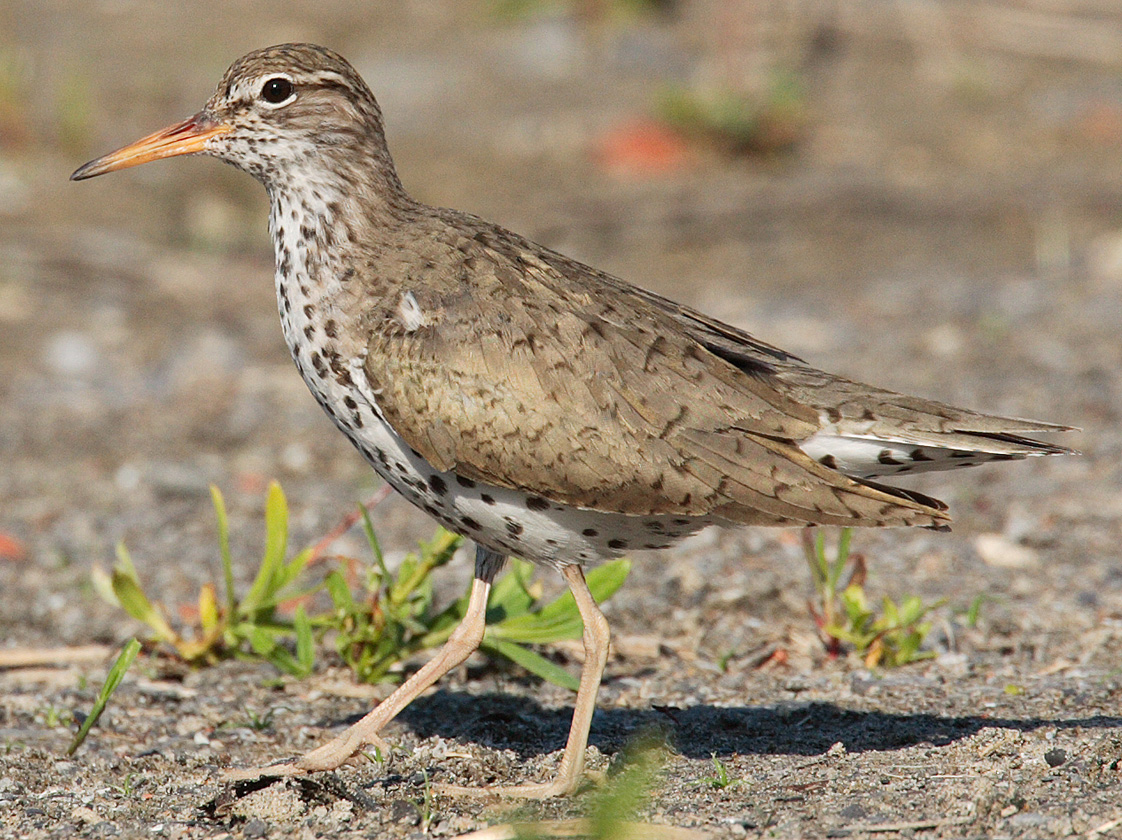
The Spotted Sandpiper is a small shorebird in the sandpiper family. It is known for its distinctive bobbing or teetering motion and, in breeding plumage, bold dark spots on its white underparts. The species is widespread across North America, breeding near various water bodies from coasts to high altitudes.
Details
Identification
Dark spots on white underparts (summer), constant tail-bobbing, short bill with orange base (summer), white wing stripe.
Social behavior
Unique polyandrous system; females defend territories and mate with multiple males, who then perform the bulk of parental care.
Diet
Insects, spiders, small crustaceans, mollusks, and occasionally small fish.
Hunting strategy
Active picking and probing along the shore; often snatches insects in flight or from the water surface.
Overwintering
Migration to subtropical and tropical regions of the Americas.
Ecology
Ecological role
Important predator for aquatic and terrestrial invertebrates; prey for birds of prey.
Natural predators
Raptors, falcons, snakes, raccoons (nest predators).
Competitor species
Other small shorebirds like the Common Sandpiper (Actitis hypoleucos) in areas of overlap.
Ecosystem service
Control of insect populations in riparian zones.
Threats
Loss of wetlands, disturbance from recreational activities on shores, pesticide use.
Scientific profile
Morphology & ID
Breeding plumage
Upperparts olive-brown with faint dark barring; underparts pure white with distinct, round, black spots that increase in size towards the belly.
Non-breeding plumage
Underparts unspotted white; upperparts plain olive-brown; greyish patches on the sides of the breast, often appearing as an incomplete collar.
Juvenile plumage
Similar to non-breeding plumage but with distinct buff and dark barring on the wing coverts and narrow pale fringes on the upperpart feathers.
Sexual dimorphism
Slight; females are on average slightly larger and often more densely and heavily spotted in breeding plumage than males.
Distinguishing features
Constant, rhythmic teetering of the rear body; characteristic shallow, stiff wingbeats in flight interspersed with short glides; short, straight bill.
Confusion species
Common Sandpiper (Actitis hypoleucos): Very similar, but lacks spots on the underparts in breeding plumage and typically has darker, greyish legs in winter.
Bill
Short, straight, and slender; orange-yellow with a black tip in breeding plumage, duller and darker (brownish) in non-breeding plumage.
Vocalization
Song
A rapid, rising series of clear whistling notes: 'weet-weet-weet-weet'.
Call
A sharp, usually disyllabic 'peet-weet' or a single 'weet'.
Distribution & migration
Breeding range
Widespread in North America, from the tree line in Alaska and Canada south to the central and southern United States.
Wintering range
Southern USA (California to Florida), Central America, Caribbean, and South America south to northern Argentina and Chile.
Migration details
Long-distance migrant; usually migrates solitarily and at night; utilizes a variety of stopover habitats along migration routes.
Habitat
Breeding habitat
Shorelines of freshwater habitats such as rivers, streams, lakes, and ponds; prefers open areas with adjacent dense vegetation for cover.
Foraging habitat
Muddy, sandy, or gravelly shores, tide pools, mangroves, sewage ponds, and occasionally wet meadows.
Breeding biology
Nest construction
A shallow scrape on the ground, often hidden under the protection of vegetation (grass, shrubs); lined with dry grass, leaves, and moss.
Eggs
Creamy to buff-beige with irregular dark brown or black blotches and spots.
Parental care
Pronounced polyandry; the male performs the majority of incubation and tending to the precocial young; females may lay multiple clutches for different males.
Diet & behaviour
Diet breeding
Insects (dragonfly larvae, beetles, flies), spiders, small crustaceans, and occasionally small fish or tadpoles.
Diet winter
Broad spectrum of invertebrates, including marine worms, small mollusks, and crustaceans in coastal habitats.
Feeding technique
Active picking of prey from the ground surface or shallow water; short sprints to pursue mobile prey.
Foraging strategy
Visual searching while constantly walking; uses the characteristic teetering motion presumably to stabilize the visual field.
Sociality
Territorial and often polyandrous during the breeding season; mostly solitary outside the breeding season, does not form large flocks.
Flock behaviour
Loose aggregations at food-rich sites possible, but no coordinated flock movements.
Protection & threats
Main threats
Habitat loss due to shoreline development and drainage of wetlands; local exposure to pesticides; disturbance from recreational activities at breeding waters.
Population trend
Stable; the species is widespread and adaptable to moderate anthropogenic changes.
Conservation measures
Preservation of natural shoreline structures; protection of wetlands under international agreements (e.g., RAMSAR); population monitoring in North America.