Rainbow Trout
Oncorhynchus mykiss
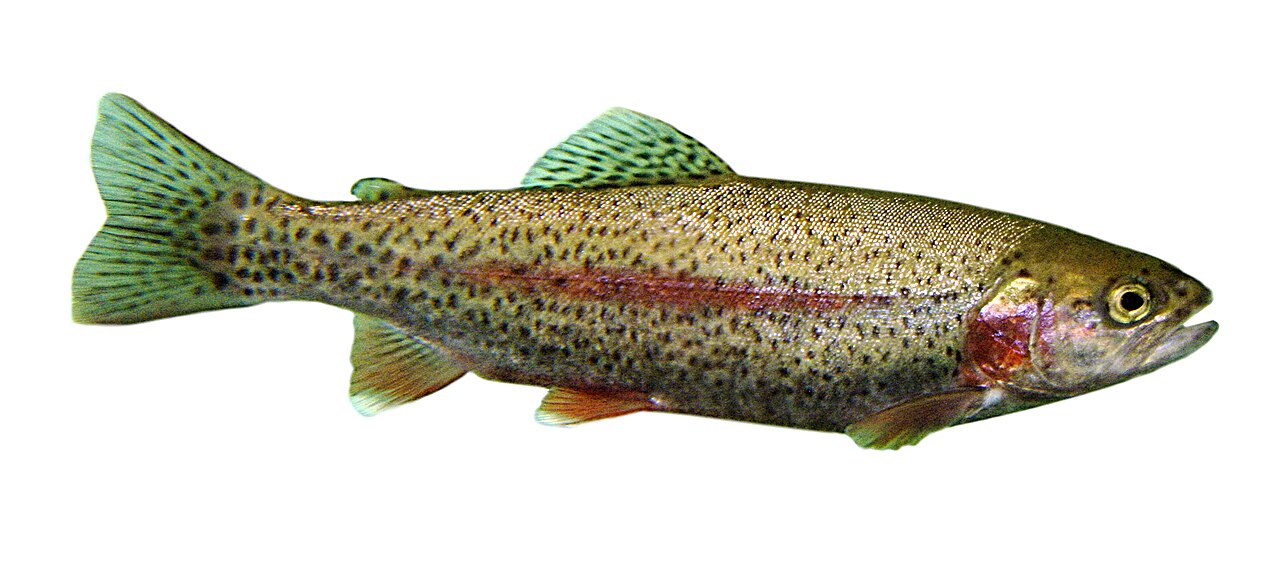
The rainbow trout is a salmonid fish native to cold-water tributaries of the Pacific Ocean in Asia and North America. It is characterized by a distinctive reddish-pink stripe along the lateral line and numerous small black spots on its body, head, and fins. Introduced globally for sport and food, it exists as both landlocked freshwater populations and anadromous forms known as steelhead.
Details
Identification
Pinkish-red lateral stripe; black spots on dorsal, adipose, and caudal fins; smaller scales than brown trout.
Social behavior
Often territorial and solitary in rivers; frequently found in loose schools in lakes or during migration.
Diet
Opportunistic predator; feeds on insect larvae, small crustaceans, annelids, and fish as it grows larger.
Hunting strategy
Visual predator that either attacks prey from cover or actively hunts in open water.
Spawning substrate
Gravel substrate in shallow, fast-flowing river sections (lithophilous spawner).
Overwintering
Reduced metabolic activity in deeper, low-current, and frost-free water zones.
Ecology
Ecological role
Apex predator in upper reaches of rivers; in direct food competition with the native brown trout.
Natural predators
Otters, grey herons, cormorants, northern pike, and larger trout.
Competitor species
Brown trout (Salmo trutta fario), Grayling (Thymallus thymallus).
Ecosystem service
High economic value through aquaculture and as a target species for recreational fishing tourism.
Threats
Water warming due to climate change, habitat loss from dams/barriers, water pollution.
Scientific profile
Morphology & ID
Coloration
Silvery-grey base coloration with a characteristic reddish-pink lateral band along the lateral line. Numerous small black spots on the back, flanks, and the dorsal and caudal fins.
Distinguishing features
Pink lateral band; adipose fin present; black spots covering the entire caudal fin (distinguishes it from brown trout); maxillary extends beyond the posterior margin of the eye; 135-150 scales along the lateral line.
Confusion species
Brown trout (Salmo trutta fario), Atlantic salmon (Salmo salar), Sea trout (Salmo trutta trutta).
Sexual dimorphism
Males develop a pronounced kype (hooked lower jaw) during the spawning season and often exhibit more intense coloration of the lateral band.
Habitat
Fish region
Trout region
Preferred zone
Pelagic and benthic zones in cool running waters and oxygen-rich lakes.
Flow preference
Fast-flowing, turbulent waters (rheophilic).
Substrate preference
Gravelly-stony substrate (lithophilic).
Oxygen requirement
Very high, prefers saturation levels near 100% (> 7 mg/L).
Migration
Migration behaviour
Partly resident in streams, partly anadromous (steelhead form), migrates to the upper reaches of river systems for reproduction.