Acute bladder snail
Physella acuta
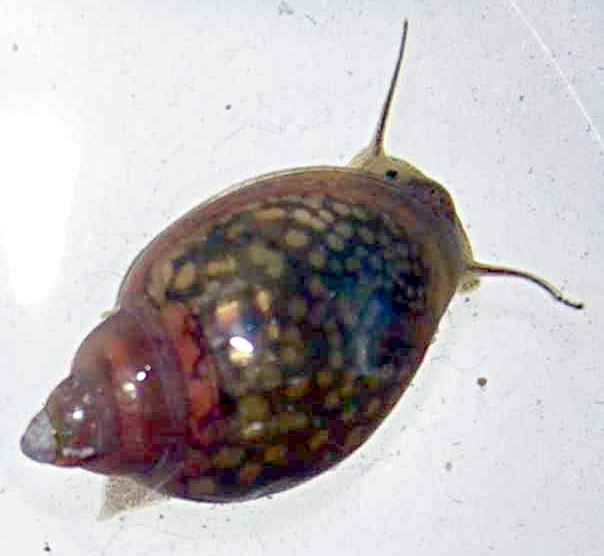
The acute bladder snail is a highly adaptable freshwater snail originally native to North America. It is characterized by a left-handed (sinistral), often translucent shell and a high tolerance for organically polluted water. In Europe, it is considered an established non-native species and inhabits a wide variety of stagnant and flowing waters, often spread through the aquarium trade or plant movement.
Details
Identification
Sinistral (left-handed), egg-shaped shell; shell wall thin and translucent; tentacles long and filiform; mantle lobes with finger-like projections.
Social behavior
Solitary, but forms very dense populations when food is abundant.
Diet
Generalist omnivore; feeds on algal biofilm, detritus, leftover fish food, and decaying plant matter.
Hunting strategy
Grazing on surfaces using a radula.
Spawning substrate
Smooth surfaces such as aquatic plants, stones, wood, or aquarium glass.
Overwintering
Overwinters in the sediment or on deeper plant parts in a state of torpor.
Ecology
Ecological role
Important decomposer in aquatic systems; contributes to the nutrient cycle by breaking down organic matter.
Natural predators
Predatory snails (e.g., Anentome helena), fish (loaches, pufferfish), leeches, water birds, and predatory insect larvae.
Competitor species
Other freshwater snails such as Lymnaea stagnalis or Planorbarius corneus.
Ecosystem service
Algae control and surface cleaning in water bodies.
Threats
No significant threats; benefits from human influence and warming waters.
Scientific profile
Profile
Distinguishing features
The main feature is the sinistral shell with a very large, wide aperture occupying about 3/4 of the total height. In contrast to the native Physa fontinalis, the spire in P. acuta is more pointed and the whorls are less convex. Additionally, it possesses a characteristic mantle edge with finger-like projections that can be reflected over the shell margin.
Diet
Periphyton (biofilm), algae, detritus, bacterial films, and occasionally decaying plant material.
Reproduction
Hermaphroditic; cross-fertilization is the rule, self-fertilization is possible when isolated. Eggs are deposited in gelatinous, kidney-shaped capsules on solid surfaces.
Role in food web
Important primary consumer; serves as a link between primary production (algae) and higher trophic levels.
Protection & threats
Main threats
None; the species is extremely adaptable and often benefits from human influences (eutrophication, warming).
Conservation measures
No conservation measures required; monitoring of its spread in sensitive ecosystems is recommended.