Raft spider
Dolomedes fimbriatus
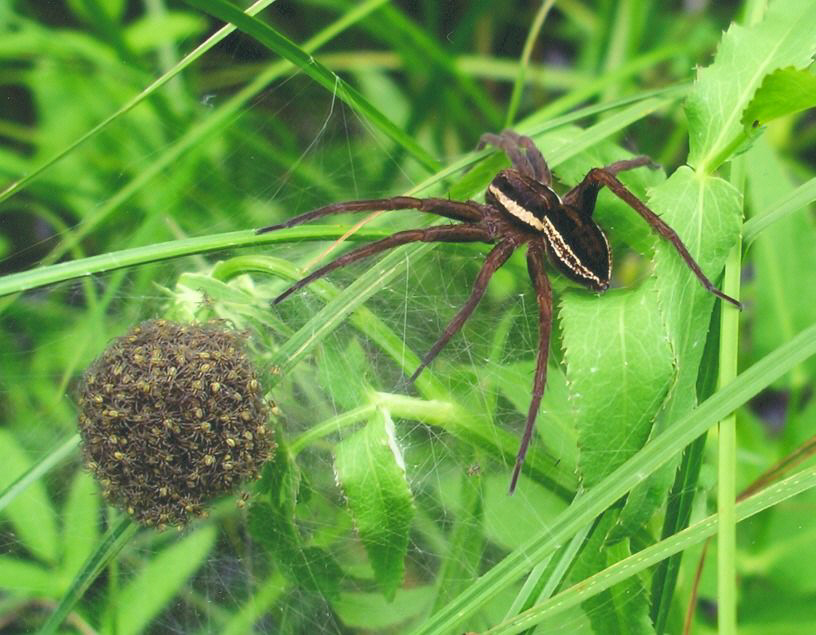
The raft spider is one of the largest native spider species in Central Europe, belonging to the nursery web spider family. It primarily inhabits bogs, marshes, and near-natural banks of standing water bodies. A striking feature is the light yellow to white longitudinal stripes on its typically dark brown body. The species is capable of running across the water surface and diving underwater when threatened or to hunt.
Details
Identification
Dark brown to olive-brown base color, two broad yellowish or white longitudinal stripes on the sides of the cephalothorax and abdomen, hairy legs.
Social behavior
Solitary; females often exhibit aggressive behavior towards males (cannibalism).
Diet
Insects (such as pond skaters or dragonfly larvae), tadpoles, and small fish.
Hunting strategy
Ambush predator; utilizes the surface tension of the water to detect vibrations from prey.
Overwintering
Overwinters twice as a sub-adult in moss cushions or dry vegetation near water bodies.
Ecology
Ecological role
Significant predator in the transition zone between water and land.
Natural predators
Birds, frogs, larger predatory spiders, and spider wasps.
Competitor species
Dolomedes plantarius (Great raft spider).
Ecosystem service
Regulation of insect populations in wetlands.
Threats
Habitat loss due to drainage of bogs and intensive land use of riparian zones.
Scientific profile
Profile
Distinguishing features
Large, robust spider with the ability to walk on the water surface and dive due to hydrophobic hairs. Females carry the spherical, brownish egg sac in their chelicerae (jaw parts) under the body. Unlike Lycosidae (wolf spiders), the eyes are arranged in two rows (4-4), with the posterior row strongly recurved.
Habitat
Strongly tied to moist to wet habitats: raised bogs, fens, carr forests, wet heathlands, and silting zones of standing or slow-moving water bodies. Prefers acidic environments.
Role in food web
Significant predator in semi-aquatic ecosystems, linking terrestrial and aquatic food chains. Regulates populations of aquatic insects.
Protection & threats
Main threats
Destruction and drainage of bogs and wetlands, eutrophication of water bodies due to nutrient input from agriculture, scrub encroachment of moors, and climate change (drying out of habitats).
Population trend
Classified on the early warning list (V) in Germany or as endangered (RL 3) in individual federal states. The trend is declining in many places due to ongoing habitat loss.