Sludge worm
Tubifex tubifex
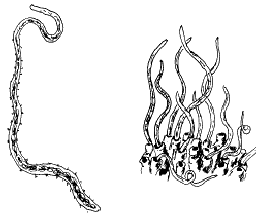
The sludge worm is a globally distributed annelid that occurs in high densities, particularly in organically polluted, oxygen-poor waters. It lives in self-constructed tubes within the sediment, with its posterior end protruding to perform rhythmic undulating movements for oxygen uptake. Due to the presence of hemoglobin, it can survive under extreme conditions with minimal oxygen levels.
Details
Identification
Thin, segmented body; reddish to brownish coloration; whipping movements of the posterior end; often appearing in dense colonies.
Social behavior
Gregarious; often forms massive aggregations ('worm fields') on the water bottom.
Diet
Feeds on detritus (sinking organic decay products) and the bacteria colonizing them.
Hunting strategy
Deposit feeder; ingests sediment and digests the contained organic matter.
Spawning substrate
Fine-grained, organic sediment.
Overwintering
Remains in the sediment; cold-resistant.
Ecology
Ecological role
Important decomposer and bioturbator; promotes the mixing and degradation of organic material in the sediment.
Natural predators
Bottom-feeding fish (e.g., carp, tench), predatory insect larvae, leeches.
Competitor species
Other oligochaetes such as Limnodrilus hoffmeisteri.
Ecosystem service
Remineralization of nutrients, self-purification of water bodies, food source for fish.
Threats
No significant threats; benefits from eutrophication; sensitive to certain heavy metals.
Scientific profile
Profile
Distinguishing features
Characteristic are the bundles of bristles (chaetae), specifically the presence of hair chaetae and bifid crotchets. A key microscopic feature for differentiation from other tubificids is the shape of the penis sheaths. In their habitat, the rhythmic waving of the posterior end in the water is a notable behavior.
Diet
Primarily bacteria, detritus, organic decomposition products, and unicellular algae.
Reproduction
Hermaphroditic with cross-fertilization. Eggs are laid in cocoons that are deposited within the sediment.
Role in food web
Important decomposer and primary consumer; serves as a significant food source for benthivorous fish and predatory invertebrates.
Protection & threats
Status not on standard scale
Main threats
No immediate threats known; the species is highly resilient to anthropogenic stressors.
Conservation measures
No specific conservation measures required; monitoring within the framework of the Water Framework Directive (WFD).