Burgundy blood algae
Planktothrix rubescens
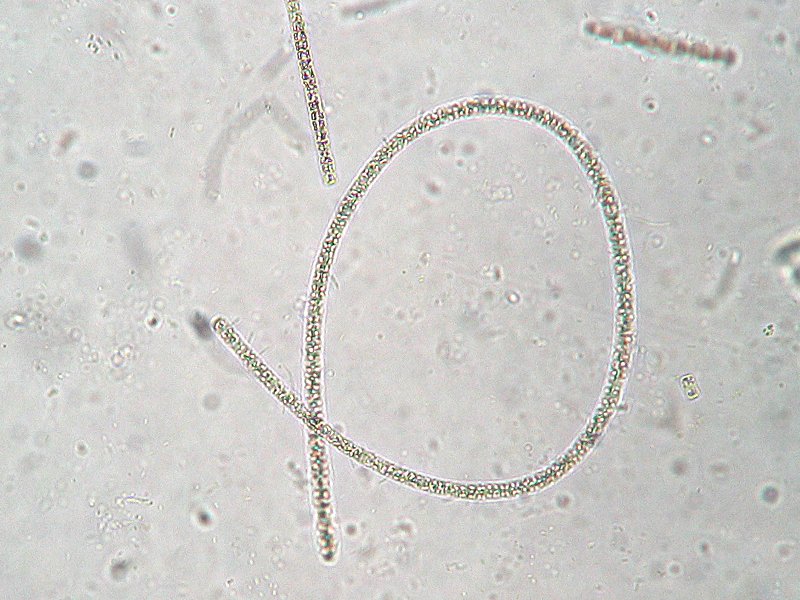
Planktothrix rubescens is a filamentous cyanobacterium characterized by its reddish to violet color due to high concentrations of the pigment phycoerythrin. It is adapted to cold, deep, oligotrophic to mesotrophic lakes and regulates its buoyancy using gas vacuoles. The species typically resides in the metalimnion but can form spectacular red water blooms at the surface during specific weather events or mixing periods. Due to the production of microcystins, it is of significant health concern for drinking water supplies and recreational water quality.
Details
Oxygen production
Produces oxygen, but mass developments and subsequent decay can lead to oxygen depletion.
Habitat function
Inhabits the thermocline (metalimnion) and utilizes nutrient gradients there.
Nutrient uptake
Highly efficient uptake of phosphate and nitrogen compounds at low light intensities.
Food source for
Limited as a food source due to toxicity and filamentous structure.
Human use
No direct use; problematic for water management (toxins, odor, taste).
Ecology
Ecological role
Primary producer, though it can harm zooplankton and higher trophic levels through toxin production (microcystins).
Natural predators
Some specialized zooplankton species (e.g., certain copepods), though often inhibited by the toxins.
Competitor species
Other phytoplankton species such as diatoms or green algae in the epilimnion.
Ecosystem service
Oxygen production through photosynthesis in deep water layers.
Threats
Climate change leads to stronger stratification and warming, which can paradoxically favor or alter its distribution in cooler lakes.
Scientific profile
Profile
Distinguishing features
Reddish coloration of trichomes; presence of numerous gas vacuoles (aerotopes) for buoyancy regulation; specialized for the metalimnion of deep lakes.
Reproduction
Asexual via fragmentation of trichomes; formation of hormogonia (short, motile filament segments).
Protection & threats
Status not on standard scale
Main threats
Nutrient management (oligotrophication reduces populations); climate change alters stratification dynamics and may favor or displace the species.
Conservation measures
No direct conservation measures required, as often classified as a problem species for water quality; monitoring of phosphorus concentrations.