Water net
Hydrodictyon reticulatum
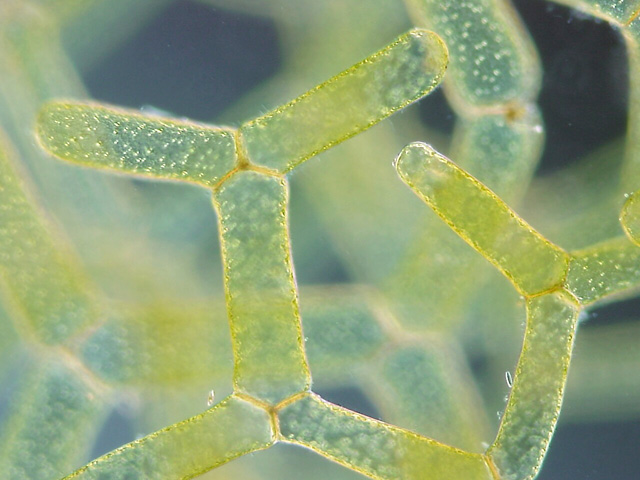
The water net is a colony-forming green alga whose individual cells are connected to form a characteristic, net-like tube. These nets can reach lengths of up to 20 centimeters and usually float freely on the water surface or in the water column. The alga prefers nutrient-rich, stagnant, or slow-moving waters. Reproduction occurs both asexually through the formation of daughter nets within the mother cells and sexually via isogamy.
Details
Oxygen production
Very high during photosynthesis during the day.
Habitat function
Provides microhabitats for microorganisms and hiding places for fish larvae.
Nutrient uptake
Very high capacity for absorbing nitrogen and phosphorus from the water.
Food source for
Herbivorous aquatic invertebrates and some fish species.
Human use
Used in biological research and experimentally for wastewater treatment (phycoremediation).
Ecology
Ecological role
Primary producer, acts as an oxygen source, but can lead to oxygen depletion in deeper layers during mass blooms.
Natural predators
Water snails, tadpoles, herbivorous fish such as the rudd.
Competitor species
Other filamentous green algae (e.g., Spirogyra) and duckweeds (Lemna spp.).
Ecosystem service
Sequestration of dissolved nutrients (nitrate, phosphate), oxygen production.
Threats
Water restoration and reduction of nutrient input (oligotrophication).
Scientific profile
Profile
Reproduction
Asexual via the formation of daughter nets within parent cells (zoospores arrange themselves directly into a net); sexual via isogamy (fusion of biflagellate gametes to form a zygote).
Protection & threats
Status not on standard scale
Main threats
Decline of nutrient-rich, warm shallow water habitats due to lake restoration (oligotrophication) or chemical pollution (herbicides).