Eurasian Teal
Anas crecca
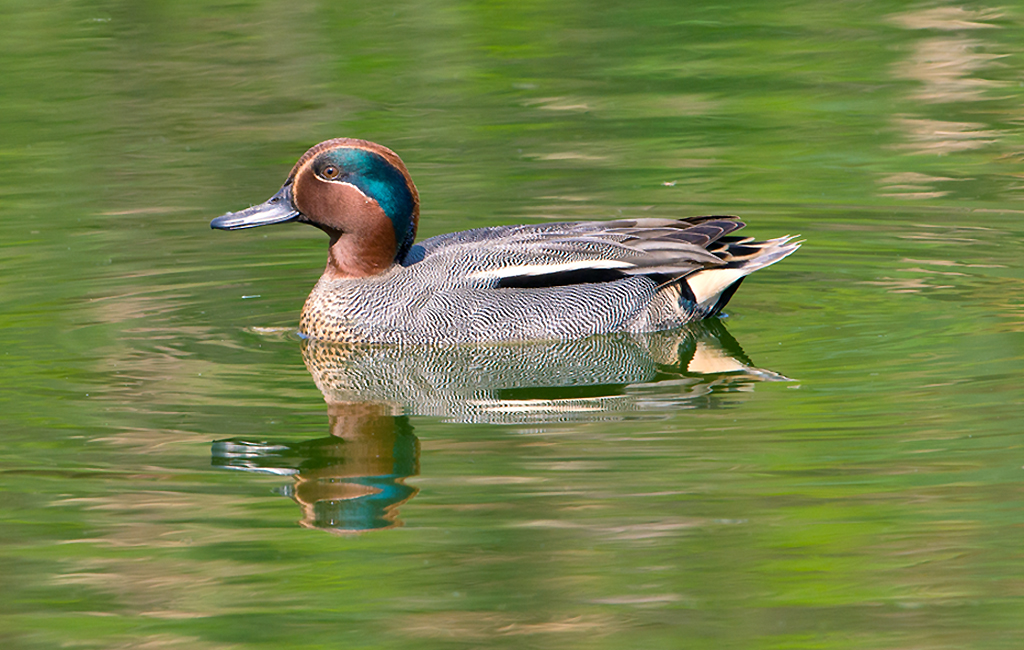
The Eurasian Teal is the smallest dabbling duck native to Europe, characterized by its compact body. Drakes in breeding plumage have a chestnut head with a broad, iridescent green eye patch, while females are inconspicuously mottled brown. It prefers shallow, nutrient-rich inland waters with dense shoreline vegetation, as well as tidal flats during winter. As a dabbling duck, it typically feeds on the water surface or in shallow shoreline areas.
Details
Identification
Very small duck; green wing speculum; males with chestnut head and green eye patch; females mottled brown.
Social behavior
Highly gregarious outside the breeding season; often forms large, dense flocks, sometimes with other duck species.
Diet
Omnivorous; feeds on plant seeds, aquatic plants as well as insect larvae, small crustaceans, and mollusks.
Hunting strategy
Dabbling in shallow water; filtering the water surface or mud for food particles.
Overwintering
Migration to ice-free regions; increasingly uses coastal waters and estuaries during winter.
Ecology
Ecological role
Important consumer in limnic ecosystems; vector for the dispersal of plant seeds (endozoochory).
Natural predators
Raptors (e.g., Peregrine Falcon), predatory mammals (fox, martens), and northern pike (for ducklings).
Competitor species
Other dabbling ducks such as Garganey or Mallard when foraging in shallow waters.
Ecosystem service
Contribution to biodiversity; seed dispersal; importance for nature tourism (birdwatching).
Threats
Loss and drainage of wetlands; disturbances at breeding sites; lead poisoning from hunting ammunition.
Scientific profile
Morphology & ID
Breeding plumage
Breeding male: Chestnut head with a broad green eye patch bordered by a thin cream line. Body finely vermiculated grey, black undertail coverts with distinct yellow triangular patches on the sides.
Non-breeding plumage
Eclipse plumage resembles the female: Mottled brown, but often with a darker crown and a more pronounced green speculum.
Juvenile plumage
Similar to the female, but with more diffuse spotting on the underparts and narrower feather fringes on the upperparts.
Sexual dimorphism
Strongly pronounced during the breeding season; males are colorful, females are cryptically brown.
Distinguishing features
Smallest European dabbling duck; green wing speculum present in both sexes; male has a characteristic head pattern.
Confusion species
Garganey (Spatula querquedula) - slightly larger, with a prominent white supercilium and blue-grey forewing.
Bill
Small, narrow, and dark grey to black.
Vocalization
Song
No true song; courtship calls of the male are a high-pitched, whistling 'krick'.
Call
Male: clear 'krick-krick'; female: high-pitched, sharp quack.
Distribution & migration
Breeding range
Vast parts of the Palearctic, from Iceland and Western Europe to Kamchatka and Japan.
Wintering range
Western and Southern Europe, North and East Africa, Near East to Southeast Asia.
Migration details
Predominantly short- to medium-distance migrant; some populations in Western Europe are residents.
Habitat
Breeding habitat
Nährstoffreiche Stillgewässer, Moore, Brüche und Sölle mit dichter Ufervegetation; bevorzugt Waldnähe.