Buff-tailed bumblebee
Bombus terrestris
The buff-tailed bumblebee is a social insect and one of the most common bumblebee species in Europe. It is characterized by its large size, black body with two distinct yellow bands, and a buff or off-white tail. This species is a highly efficient generalist pollinator found in diverse habitats including gardens, parks, and agricultural land. It forms large colonies of up to 600 workers and typically nests underground in abandoned rodent burrows.
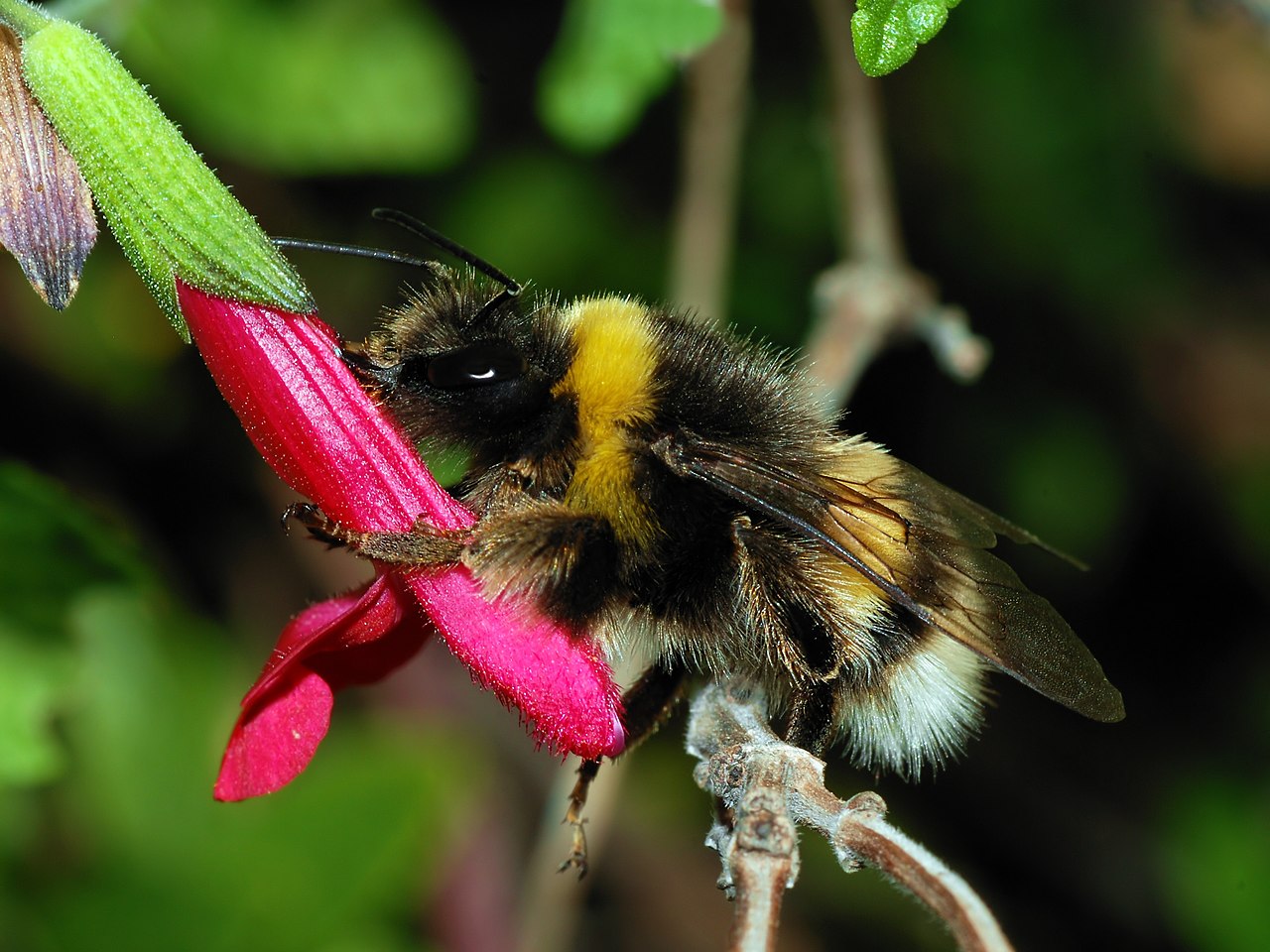
Details
Identification
Two golden-yellow bands (one on the thorax, one on the second abdominal segment), tail tip is white or buff-colored, short proboscis.
Social behavior
Eusocial; forms annual summer colonies with a single queen and specialized worker castes.
Diet
Generalist; feeds on nectar and pollen from a wide variety of plant species (polylectic).
Spawning substrate
Underground cavities, mostly abandoned small mammal burrows.
Overwintering
Only the mated young queens overwinter in self-dug underground burrows or under leaf litter.
Ecology
Ecological role
Crucial pollinator for wild and cultivated plants; capable of buzz pollination.
Natural predators
Birds (e.g., shrikes), badgers (nest predators), cuckoo bumblebees, robber flies, crab spiders.
Competitor species
Other bumblebee species (e.g., B. lucorum), honeybees, and solitary wild bees.
Ecosystem service
Pollination of crops (tomatoes, berries) and maintenance of floral biodiversity.
Threats
Habitat loss, pesticide use (neonicotinoids), lack of floral resources due to monocultures, climate change.
Scientific profile
Profile
Distinguishing features
Short proboscis (genus Bombus, subgenus Bombus sensu stricto); queens are very large, reaching up to 28 mm; yellow bands are typically darker and narrower compared to B. lucorum; workers are often indistinguishable from B. lucorum in the field (cryptic species complex).
Habitat
Euryoecious: Inhabits almost all open and semi-open habitats including gardens, parks, agricultural landscapes, forest edges, and ruderal areas.
Protection & threats
Main threats
Pesticide use (neonicotinoids), lack of food in simplified agricultural landscapes, pathogen spillover from commercially bred bumblebees, climate change (heat stress).
Population trend
Stable; the species is highly adaptable and is increasingly expanding northward due to milder winters.
Conservation measures
Preservation and creation of flower strips, reduction of pesticides, promotion of structurally diverse gardens and fallow land.