Common barbel
Barbus barbus
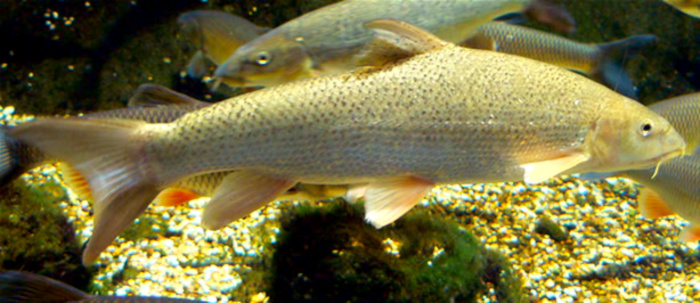
The common barbel (Barbus barbus) is a robust, spindle-shaped freshwater fish belonging to the cyprinid family. It is the eponymous indicator species of the barbel zone, preferring fast-flowing, oxygen-rich waters with sandy or gravelly substrates. Distinctive features include its inferior, protrusible mouth and four thick barbels on the upper lip used for foraging in the sediment. During the breeding season, barbels often undertake long upstream migrations to deposit their eggs in shallow, gravelly areas.
Details
Identification
Four barbels on the upper lip, inferior protrusible mouth, spindle-shaped body, hard and serrated third ray of the dorsal fin.
Social behavior
Gregarious species living in schools; especially juveniles and resting adults often form larger groups.
Diet
Feeds benthically on insect larvae, amphipods, mollusks, snails, and occasionally small fish.
Hunting strategy
Roots through the substrate with its protrusible mouth; barbels are used to locate prey within the sediment.
Spawning substrate
Clean gravel and coarse sand (lithophilic).
Overwintering
Overwinters in deeper, slow-flowing pools or calm river sections.
Ecology
Ecological role
Important benthic consumer and prey for large predatory fish (catfish, pike) as well as piscivorous birds and mammals.
Natural predators
Wels catfish, Northern pike, Great cormorant, Goosander, Eurasian otter.
Competitor species
Common bream, Chub, Common nase (partial overlap in feeding niche or habitat).
Ecosystem service
Bioturbation of the sediment during foraging, which promotes nutrient cycling and oxygen supply within the gravel.
Threats
River fragmentation (migration barriers), loss of gravel spawning sites due to siltation, water pollution.
Scientific profile
Morphology & ID
Coloration
Back olive-green to brownish, sides shimmering golden or bronze, belly whitish. Paired fins often have a reddish tint.
Distinguishing features
Four thick barbels on the fleshy upper lip (two at the front, two at the corners). Snout-like, inferior mouth. The last unbranched dorsal fin ray is strong and serrated on the posterior edge.
Confusion species
Mediterranean barbel (Barbus meridionalis) - has a smooth dorsal ray; Gudgeon (Gobio gobio) - significantly smaller, possesses only two barbels.
Sexual dimorphism
Males develop fine spawning tubercles on the head and back during the breeding season; females are on average significantly larger and heavier than males of the same age.
Habitat
Fish region
Barbel region (Epipotamon)
Preferred zone
Benthic (bottom-dwelling)
Flow preference
Rheophilic; prefers fast-flowing, oxygen-rich water sections with turbulent currents.
Substrate preference
Lithophilic; prefers clean gravel, pebbles, and coarse sand without significant siltation.
Oxygen requirement
High; requires well-aerated water (> 6-7 mg/L), sensitive to organic pollution and oxygen depletion.
Migration
Migration behaviour
Potamodromous; undertakes extensive upstream spawning migrations in spring (up to 300 km) to reach suitable gravel beds in shallower areas.
Reproduction
Spawning substrate
Gravelly or stony substrate (lithophilic) in shallow, fast-flowing, and well-oxygenated areas.
Larval phase
After hatching, larvae initially stay in the interstitial spaces of the gravel before migrating to shallow, slow-flowing shore zones.
Parental care
No parental care; the sticky eggs are deposited in the gravel, and the larvae are independent after hatching.
Diet
Feeding type
Benthivorous (bottom feeder)
Diet juvenile
Small zooplankton organisms and small benthic invertebrates such as chironomid larvae.
Diet adult
Invertebrates (insect larvae, mollusks, crustaceans, annelids), occasionally fish eggs or small fish (e.g., bullheads).
Feeding strategy
Searches the riverbed for food using highly sensitive barbels; actively roots through the substrate and turns over stones.
Schooling
Gregarious; often forms groups or schools outside the spawning season, resting together in deep pools or under cover.
Ecological role
Role in food web
Secondary consumer; important link between benthic production and large predatory fish as well as piscivorous birds.
Natural predators
Pike, catfish, cormorant, otter; juveniles are also preyed upon by perch and trout.
Competitor species
Common nase (Chondrostoma nasus) regarding spawning site usage; bream (Abramis brama) in transition zones to calmer sections.
Parasites
Various trematodes, nematodes, acanthocephalans, and fish lice (Argulus foliaceus).
Bioindicator function
Key species of the barbel region; indicator for good water quality (Saprobic Index ~2.0) and the ecological connectivity of river systems.
Fisheries & legal
Fishing regulation
Regulated by regional fishery ordinances; subject to closed seasons and minimum size limits.
Closed season
Varies regionally, mostly from May 1st to June 15th (e.g., Bavaria, NRW).
Economic use
Significant game fish for recreational angling; commercially of low importance due to numerous intramuscular bones, but locally valued as a food fish.
Protection & threats
Main threats
Transverse structures (loss of connectivity), loss of gravel spawning grounds due to fine sedimentation, water pollution, and cormorant predation in small populations.
Population trend
Stable to slightly recovering in Central Europe as a result of restoration measures, but still locally threatened by habitat fragmentation.
Conservation measures
Restoration of longitudinal connectivity (fish passes), revitalization of gravel beds, reduction of nutrient and fine sediment inputs.