Greater mouse-eared bat
Myotis myotis
The Greater mouse-eared bat is the largest bat species native to Central Europe. It is characterized by its broad wings, a distinctive mouse-like snout, and its namesake large ears. The species prefers open landscapes and sparse deciduous forests, often establishing maternity colonies in large, undisturbed attics of churches or castles. During winter, it retreats to cool, humid caves, tunnels, or cellars for hibernation. Due to its specialized ground-gleaning hunting strategy, it occupies a unique ecological niche.
Details
Identification
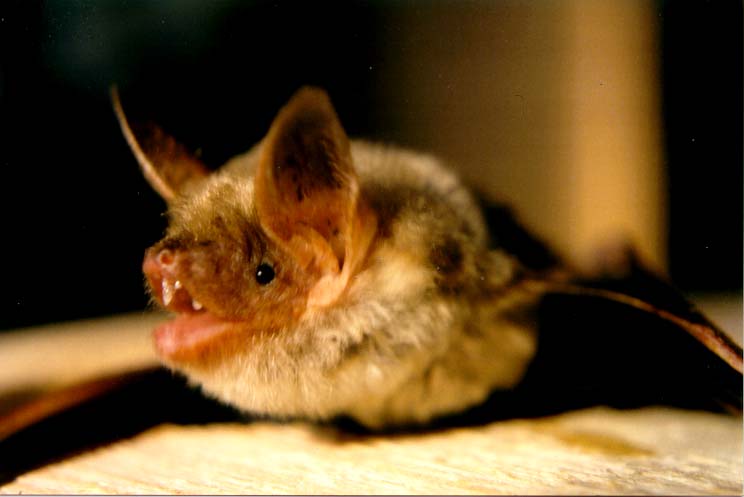
Large ears with a narrow tragus, broad snout, brownish-grey dorsal fur, almost white underside, forearm length 60-68 mm.
Social behavior
Gregarious; forms large maternity colonies of hundreds of females; males usually live solitarily during summer.
Diet
Mainly ground-dwelling arthropods, especially large ground beetles, but also crane flies, crickets, and spiders.
Hunting strategy
Ground gleaning; locates prey passively by listening for crawling sounds and picks them up from the ground.
Overwintering
Hibernation in underground quarters with high humidity and stable temperatures.
Ecology
Ecological role
Important predator of insects; contributes to the biological control of beetle species relevant to forestry.
Natural predators
Owls (especially barn owl and tawny owl), martens, domestic cats.
Competitor species
Other large Myotis species when competing for optimal roosting sites.
Ecosystem service
Biological pest control in forests and on agricultural land.
Threats
Loss of roosts due to building renovation, use of insecticides, fragmentation of foraging habitats.
Scientific profile
Profile
Distinguishing features
Largest Myotis species in Europe. Characteristic features include broad ears with a tragus reaching about half the ear length, and a short, broad snout. Forearm length is typically between 55 and 68 mm.
Habitat
Prefers open deciduous and mixed forests with a hall-like structure and little undergrowth (hunting habitat). Summer roosts are located in warm attics of churches or castles, while winter roosts are frost-free caves and mines.
Diet
Primarily large, ground-dwelling arthropods, especially ground beetles (Carabidae), but also spiders, crickets, and occasionally cockchafer larvae.
Protection & threats
Main threats
Loss of roosts due to building renovation, use of insecticides in agriculture and forestry (lack of food), and habitat fragmentation.
Population trend
After massive declines in the mid-20th century, populations in Central Europe currently show a stable to slightly positive trend.
Conservation measures
Protection and preservation of maternity roosts, bat-friendly renovation of buildings, promotion of structurally rich deciduous forests, and reduction of pesticides.