Freshwater dinoflagellate
Ceratium hirundinella
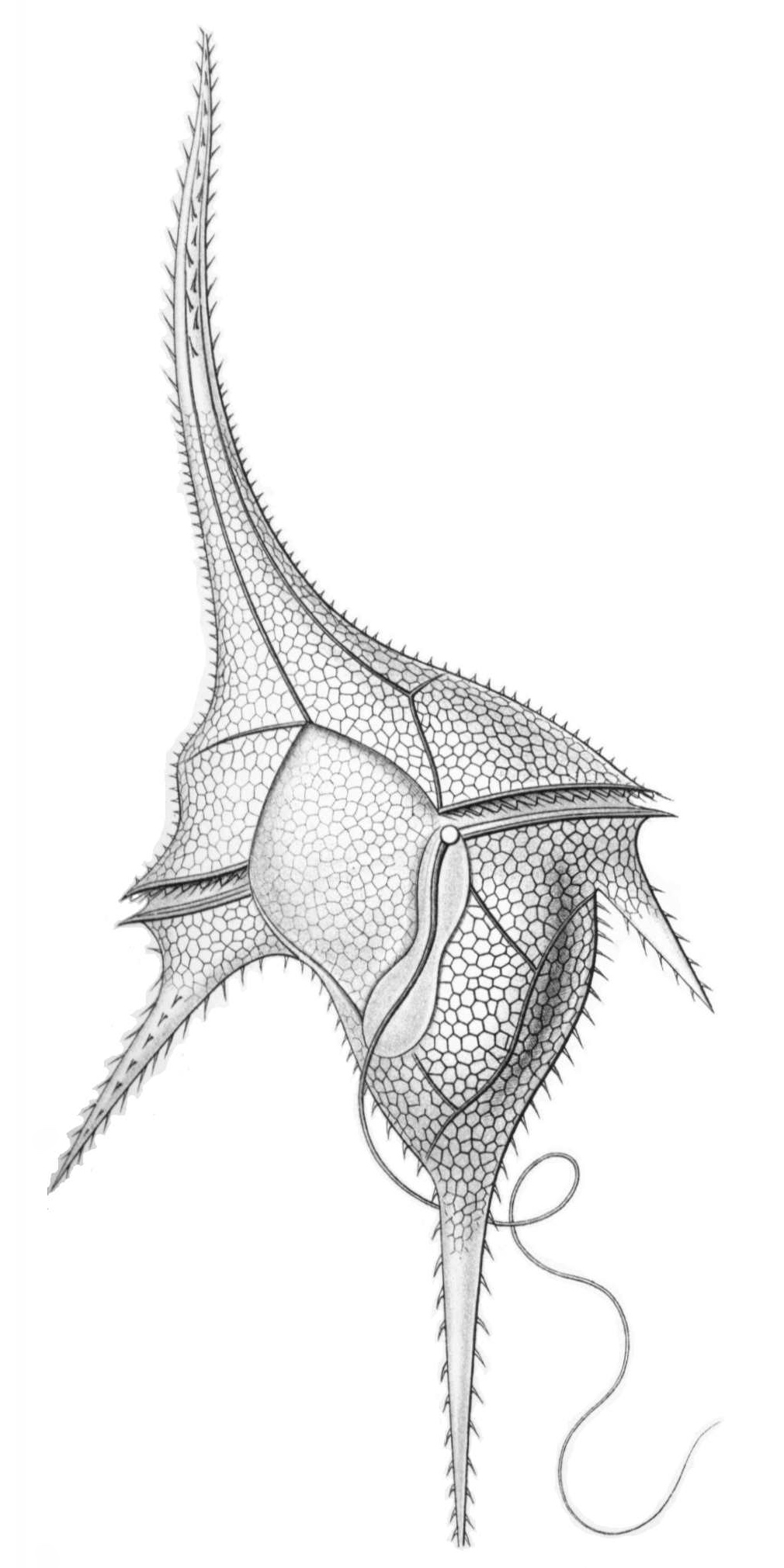
Ceratium hirundinella is a common freshwater dinoflagellate known for its distinct shape featuring one apical and two to three antapical horns. These structures aid in buoyancy and protection against predators within the water column of lakes and ponds. It is a primary producer that uses photosynthesis but is also capable of mixotrophy, allowing it to ingest organic matter when nutrients are scarce.
Details
Oxygen production
Contributes significantly to oxygen saturation in the epilimnion of lakes during summer months.
Habitat function
Component of the pelagic community; provides the biomass base for higher trophic levels.
Nutrient uptake
Efficient uptake of phosphates and nitrates from the water column.
Food source for
Zooplankton (rotifers, small crustaceans).
Human use
No direct economic use; serves as a model organism for ecological studies in research.
Ecology
Ecological role
Important primary producer in the pelagic food web; serves as a food source for herbivorous zooplankton such as rotifers and daphnia.
Natural predators
Zooplankton (e.g., daphnia, rotifers), planktivorous juvenile fish.
Competitor species
Other phytoplankton species such as green algae or cyanobacteria competing for light and nutrients.
Ecosystem service
Oxygen production through photosynthesis and fixation of atmospheric carbon.
Threats
Excessive eutrophication (can lead to algal blooms), chemical water pollution from herbicides.
Scientific profile
Profile
Distinguishing features
Very large cells, nearly visible to the naked eye during blooms; prominent horn formation; thick, sculptured thecal plates; active vertical migration using two flagella (transverse and longitudinal).
Reproduction
Primarily asexual via longitudinal fission; sexual reproduction (isogamy) leads to the formation of thick-walled resting cysts (hypnozygotes) for overwintering.
Protection & threats
Status not on standard scale
Main threats
Extreme eutrophication (hypertrophy) favoring cyanobacterial blooms; chemical contamination; drastic changes in stratification dynamics due to climate change.
Conservation measures
Reduction of diffuse nutrient inputs from agriculture; maintenance of natural stratification dynamics; monitoring of phytoplankton composition according to the WFD.