Caddisfly
Trichoptera
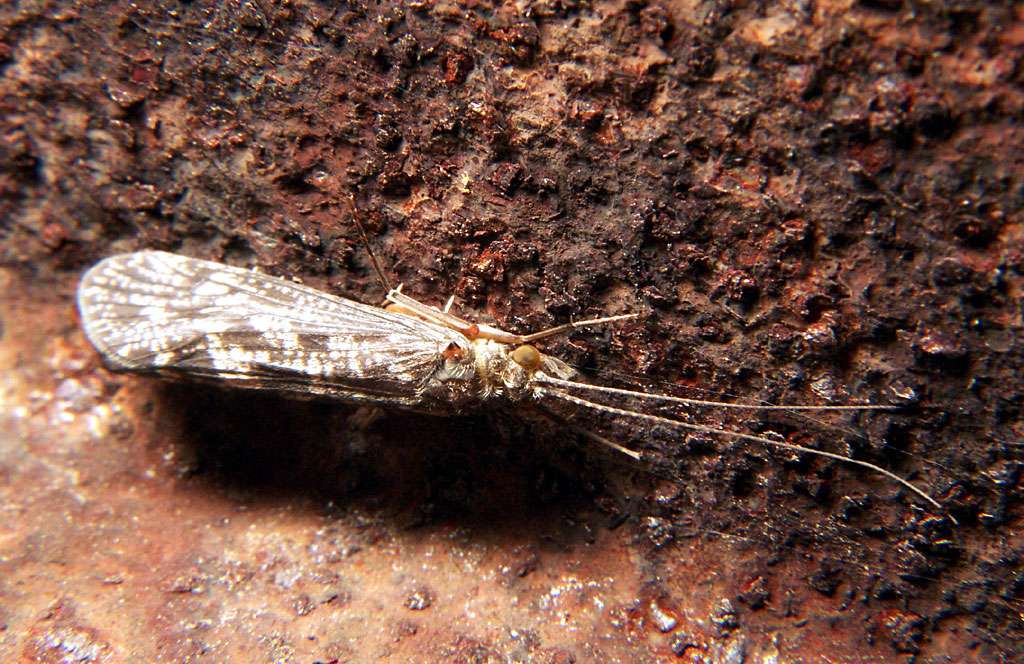
Caddisflies are a globally distributed order of insects whose larval stages are found almost exclusively in freshwater habitats. They are closely related to moths and butterflies but are distinguished by having hairy rather than scaly wings in the adult stage. A prominent feature of many larvae is the construction of protective cases or 'quivers' made from sand, stones, or plant debris, held together by silk. As adults, they are mostly crepuscular or nocturnal and hold their wings roof-like over their abdomen when at rest.
Details
Identification
Hairy wings (forewings often patterned), long filiform antennae, lack of a proboscis (only licking mouthparts), larvae with abdominal hooks and often with cases.
Social behavior
Adults and larvae are predominantly solitary but can occur in very high population densities in favorable locations.
Diet
Larvae are diverse: detritivores, algal grazers, predators (building capture nets), or omnivores. Adults mostly consume only liquid food such as nectar or water.
Hunting strategy
Some larval families (e.g., Hydropsychidae) build stationary funnel nets in the current to catch plankton and small organisms.
Spawning substrate
Stones, aquatic plants, or wood and riparian vegetation hanging into the water.
Overwintering
Overwintering usually occurs in the larval stage or as eggs within the aquatic substrate.
Ecology
Ecological role
Important primary consumers and decomposers that shred organic matter (leaf litter); they are a fundamental food source for fish and waterfowl.
Natural predators
Fish (trout, grayling), dragonfly larvae, dippers, bats, and spiders.
Competitor species
Other benthic invertebrates such as mayfly larvae (Ephemeroptera) or amphipods.
Ecosystem service
Contribution to the self-purification of water bodies through filtration; transfer of aquatic biomass into terrestrial ecosystems.
Threats
Water pollution, chemical inputs (insecticides), loss of riparian buffer zones, dams/weirs in rivers, and light pollution.
Scientific profile
Profile
Distinguishing features
Hairy wings (Trichoptera = hair-wings), long filiform antennae (often as long as or longer than the body), roof-like wing posture at rest; adults have reduced mouthparts (licking organs only), no scales unlike Lepidoptera.