Stentor
Stentor
Stentors are trumpet-shaped, single-celled organisms belonging to the group of ciliates, primarily found in nutrient-rich freshwater habitats. Measuring up to two millimeters in length, they are among the largest extant unicellular organisms and can often be spotted with the naked eye. They are characterized by a prominent ring of cilia at the anterior end used for filter feeding and possess remarkable regenerative capabilities. When disturbed, they utilize highly developed contractile fibers to rapidly shrink into a spherical shape within milliseconds.
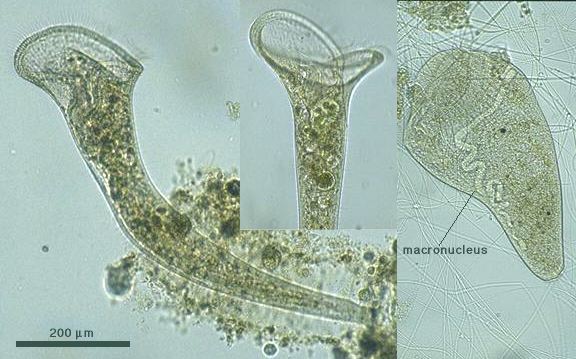
Details
Identification
Trumpet- or funnel-shaped body, large ring of cilia at the anterior end (peristome), often vibrantly colored (e.g., blue-green in S. coeruleus), highly contractile.
Social behavior
Mostly solitary, but can form dense colonies on substrates such as aquatic plants when food is abundant.
Diet
Feeds on bacteria, algae (phytoplankton), and smaller protozoa, which are drawn into the cytostome by the beating of the ciliary wreath.
Hunting strategy
Filter feeder; creates a water current to effectively filter food particles and smaller organisms from the surrounding water.
Overwintering
Formation of resting stages (cysts) to survive freezing temperatures or desiccation.
Ecology
Ecological role
Important primary consumer and decomposer in the microbial loop; regulates bacterial populations in aquatic ecosystems.
Natural predators
Larger zooplankton, small crustaceans (such as Daphnia), and predatory protozoa.
Competitor species
Other ciliates such as Paramecium or Vorticella.
Ecosystem service
Contribution to the biological self-purification of water bodies by filtering bacteria and detritus.
Threats
Extreme chemical pollution, toxic algal blooms, and complete desiccation of habitats.
Scientific profile
Profile
Habitat
Freshwater ecosystems; prefers stagnant or slow-moving waters (ponds, lakes, ditches). Often associated with aquatic macrophytes or detritus-rich surfaces.
Reproduction
Asexual reproduction by transverse binary fission; sexual processes via conjugation for genetic exchange.
Ecological role
Important predator in the microbial loop; regulates bacterial and algal populations and serves as a link to higher trophic levels.