Northern Pike
Esox lucius
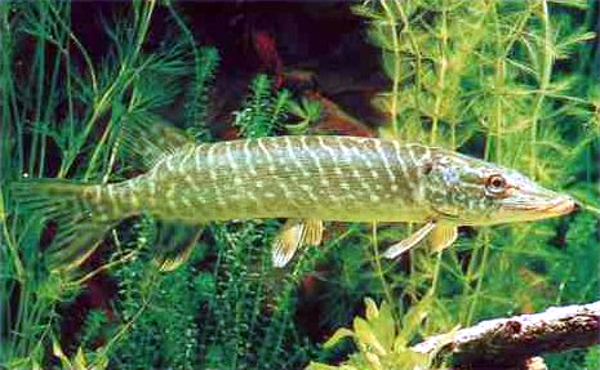
The Northern Pike is a large, predatory freshwater fish characterized by its elongated, torpedo-shaped body and dorsal and anal fins positioned far back. It inhabits standing and slow-moving waters as well as brackish regions across the entire Northern Hemisphere. As an ambush predator, it is perfectly adapted to its environment, utilizing its speed for short, explosive attacks on prey. It is considered one of the most important apex predators in European inland waters.
Details
Identification
Duck-bill shaped snout with approx. 700 teeth, dorsal and anal fins set far back, light spots on a dark background.
Social behavior
Solitary and highly territorial; exhibits pronounced cannibalism towards smaller conspecifics.
Diet
Mainly fish, but also frogs, small mammals (e.g. mice), and waterfowl.
Hunting strategy
Ambush predator (strike predator) that remains motionless in vegetation and strikes lightning-fast.
Spawning substrate
Aquatic plants or flooded meadows (phytophilous spawner).
Overwintering
Retreats to deeper, frost-free water layers; reduced activity but no hibernation.
Ecology
Ecological role
Apex predator; regulates fish populations and prevents the mass expansion of prey fish populations.
Natural predators
Larger pike, otters, cormorants, and grey herons.
Competitor species
Zander, Wels catfish, European perch (food competition).
Ecosystem service
Regulation of fish stocks, high economic importance for recreational and commercial fishing.
Threats
Loss of spawning habitats due to bank stabilization and drainage, water pollution.
Scientific profile
Morphology & ID
Coloration
Variable depending on habitat; usually greenish-brown with yellowish spots or irregular transverse bars; ventral side whitish.
Distinguishing features
Dorsal and anal fins positioned far back (near the caudal fin); deeply cleft mouth with numerous needle-like teeth; approx. 110-150 scales along the lateral line.
Confusion species
Hardly any risk of confusion in Europe; in North America with the Muskellunge (Esox masquinongy) or the Chain Pickerel (Esox niger).
Sexual dimorphism
Females grow significantly larger and heavier than males (sexual dimorphism in body size).
Habitat
Fish region
Bream zone as well as standing waters (lakes, ponds) and brackish water areas (coastal lagoons).
Preferred zone
Littoral zone (near-shore areas with dense vegetation).
Flow preference
Lentic (standing) to weakly lotic (slow-moving).
Substrate preference
Phytophilous; prefers weed-rich substrates and submerged deadwood.
Oxygen requirement
Moderate to high; tolerant of short-term reductions, but requires oxygen-rich water for embryonic development.
Migration
Migration behaviour
Short-distance migrations to suitable spawning grounds (flooded meadows, shallow water zones).
Reproduction
Spawning substrate
Submerged aquatic plants, grasses on flooded meadows (adhesive spawner).
Larval phase
After hatching, the larvae attach themselves to aquatic plants using an adhesive gland on the head until the yolk sac is absorbed.
Parental care
No parental care.
Diet
Feeding type
Piscivorous (predatory fish).
Diet juvenile
Zooplankton, insect larvae, small crustaceans; transition to piscivory at a length of approx. 4-6 cm.
Diet adult
Primarily fish (including cannibalism), occasionally frogs, small mammals (muskrats), and waterfowl.
Feeding strategy
Ambush predator; uses cover to capture prey in a rapid strike.
Schooling
Solitary; pronounced territorial behavior.
Ecological role
Role in food web
Apex predator in many limnic ecosystems; regulates populations of forage fish.
Natural predators
Larger conspecifics, European otter, cormorants, grey heron (for juveniles).
Competitor species
Zander (Sander lucioperca), European perch (Perca fluviatilis), Wels catfish (Silurus glanis).
Parasites
Pike tapeworm (Triaenophorus nodulosus), fish leech (Piscicola geometra), thorny-headed worms (Acanthocephala).
Bioindicator function
Indicator for the structural quality of littoral zones and the presence of macrophytes.
Fisheries & legal
Fishing regulation
Regulated by state fishery ordinances; closed seasons and minimum size limits are mandatory.
Closed season
Varies regionally, usually between February 1st and April 30th.
Economic use
High-quality food fish; of great importance for commercial inland fisheries and angling tourism.
Protection & threats
Main threats
Loss of spawning habitats due to bank stabilization, drainage of floodplains, and decline of aquatic vegetation (eutrophication).
Population trend
Stable in near-natural waters; declining in heavily anthropogenically modified systems lacking shallow water zones.
Conservation measures
Restoration of shorelines and floodplains, protection of reed belts, restoration of river continuity.