Hoary Plantain
Plantago media
Hoary Plantain is a perennial herbaceous plant most notable for its dense, basal rosette of leaves. The leaves are broad-elliptical in shape and covered with fine white hairs on both sides, giving them a distinct greyish-green hue. During the flowering period, erect and leafless stalks emerge, topped with cylindrical spikes that feature prominent light violet stamens. This species prefers sunny, dry locations on calcareous soils, such as semi-dry grasslands or nutrient-poor meadows. It serves as an important food source for numerous insects and acts as an indicator for low-nitrogen, base-rich soil conditions.
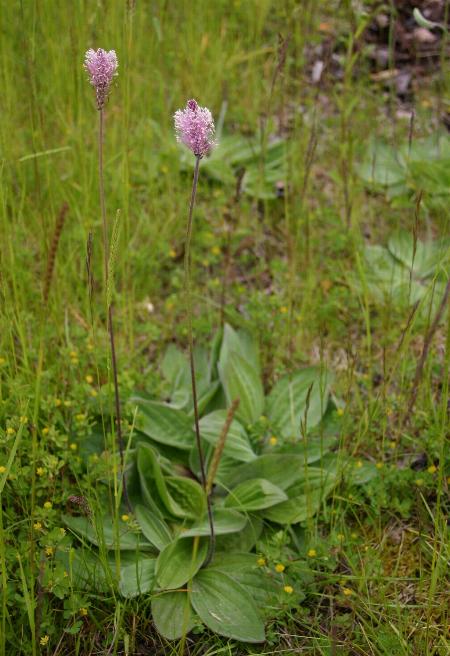
Details
Habitat function
Structural component in sparse grassland communities; oviposition site for insects.
Nutrient uptake
Adapted to efficient nutrient utilization in nitrogen-poor soils.
Food source for
Glanville fritillary (Melitaea cinxia), wild bees (e.g., Andrena species), and hoverflies.
Human use
Traditional medicinal plant for respiratory diseases and inflammation; young leaves are edible (wild vegetable).
Ecology
Ecological role
Important pollen source for wild bees and hoverflies as well as a host plant for specialized butterfly larvae.
Natural predators
Fritillary butterfly larvae, various beetle species, and grazing ungulates.
Competitor species
Competes with grasses and other herbs of dry grasslands; displaced by more competitive tall grasses when over-fertilized.
Ecosystem service
Soil stabilization on slopes and support of pollinator biodiversity.
Threats
Eutrophication through nitrogen input, conversion of nutrient-poor grasslands into arable land, and abandonment of extensive grazing.
Scientific profile
Profile
Reproduction
Generative via seeds; the plant is a perennial hemicryptophyte.
Protection & threats
Main threats
Eutrophication via nitrogen deposition, abandonment of traditional land use (scrub encroachment), conversion of grassland to arable land, and overgrazing or excessive mowing.