Lucerne Flea
Sminthurus viridis
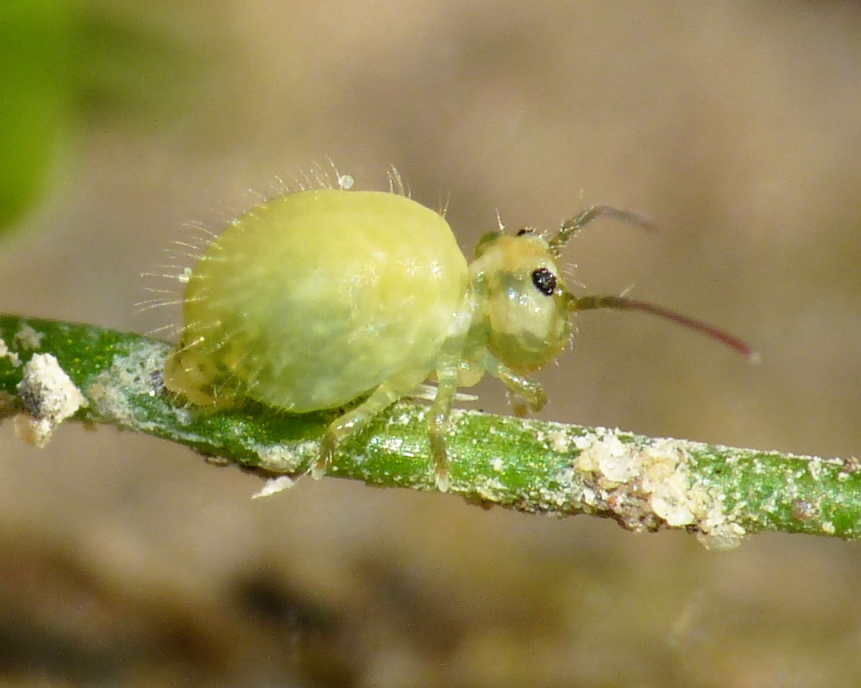
The Lucerne flea is a wingless hexapod belonging to the class Collembola (springtails). It is characterized by a nearly spherical body formed by the fusion of the posterior body segments. The species is typically light green and possesses a well-developed jumping organ (furca), allowing it to make large leaps when threatened.
Details
Identification
Globular body shape; light green to yellowish coloration; four-segmented antennae; large furca on the underside of the abdomen; wingless.
Social behavior
Often found in high population densities, but does not exhibit true social behavior.
Diet
Feeds on fungal hyphae, bacteria, detritus, and living plant tissue, especially legumes such as lucerne and clover.
Spawning substrate
Moist soil or plant debris.
Overwintering
Overwintering usually occurs in the egg stage or as adults in the leaf litter.
Ecology
Ecological role
Important primary consumer and decomposer; contributes to humus formation and serves as prey for predatory arthropods.
Natural predators
Predatory mites, spiders, rove beetles, ground beetles.
Competitor species
Other phytophagous springtails and small insects of the herb layer.
Ecosystem service
Soil aeration and support of the nutrient cycle through the decomposition of organic matter.
Threats
Intensive agriculture, use of broad-spectrum insecticides, soil sealing.
Scientific profile
Profile
Distinguishing features
Globular body shape without visible segmentation of the abdomen (typical for Symphypleona). Possesses a well-developed jumping organ (furca). Unlike most other Collembola, this species lives primarily on vegetation rather than in the soil.
Habitat
Open land habitats, especially moist grasslands, meadows, pastures, and clover fields. Also found in gardens and ruderal areas.
Diet
Phytophagous; feeds on living plant tissue by scraping off the epidermis and mesophyll of leaves (skeletonizing).
Role in food web
Primary consumer; important prey for predatory arthropods such as mites (e.g., Bdellidae), spiders, and rove beetles.
Protection & threats
Status not on standard scale
Main threats
Intensive agriculture (use of broad-spectrum insecticides), drainage of wet meadows, and prolonged periods of drought.
Population trend
Stable; the species is widespread and common in Central Europe.
Conservation measures
Maintenance of extensively managed grassland, avoidance of insecticides in fodder production, and protection of the soil water balance.