Variable Leafcutter Bee
Megachile versicolor
The Variable Leafcutter Bee is a medium-sized solitary wild bee from the Megachilidae family. It is widely distributed across Europe and inhabits various environments such as forest edges, gardens, and parks. It is well-known for its method of cutting circular pieces from leaves to line its brood cells within cavities.
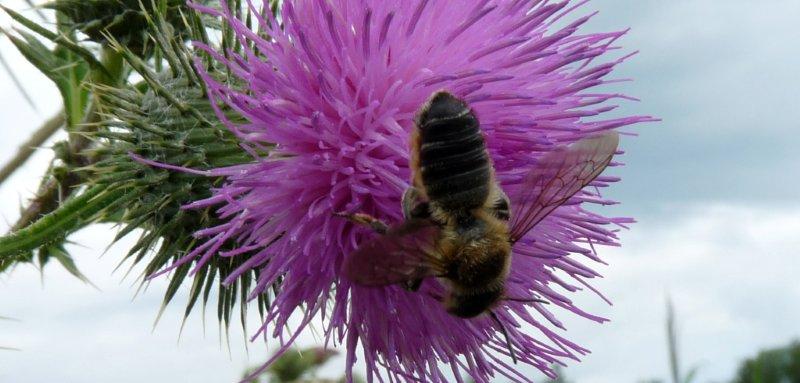
Details
Identification
Stocky body build; females with whitish to reddish abdominal scopa; tergites often with narrow, light hair bands at the end.
Social behavior
Solitary; each female builds and provisions her own nest without cooperation from conspecifics.
Diet
Polylectic; visits flowers from many families such as legumes (Fabaceae), composites (Asteraceae), and rose family (Rosaceae).
Spawning substrate
Nesting cavities in dead wood, pithy stems (e.g., bramble), or beetle boreholes.
Overwintering
Overwintering as a resting larva (prepupa) in a protective cocoon within the nest cell.
Ecology
Ecological role
Important pollinator for a variety of wild and cultivated plants in various ecosystems.
Natural predators
Cuckoo bees of the genus Coelioxys (sharp-tailed bees), ichneumon wasps, and insectivorous birds.
Competitor species
Other above-ground nesting Megachile species and mason bees (Osmia).
Ecosystem service
Ensuring plant reproduction through efficient pollination services.
Threats
Loss of nesting sites due to intensive forestry and lack of floral diversity in the agricultural landscape.
Scientific profile
Profile
Distinguishing features
Females possess 4-toothed mandibles and a characteristic bicolored scopa (yellowish-red/black). Males do not have widened front tarsi (distinguishing them from M. maritima) and feature a deeply notched apical tergite. The species is morphologically very similar to Megachile centuncularis but differs by the black hairs at the tip of the ventral scopa.
Habitat
Diverse open to semi-open habitats: forest edges, clearings, forest openings, gardens, parks, sand pits, and dry edge structures.
Protection & threats
Main threats
Loss of nesting opportunities due to removal of dead wood and pruning of hedges; decline in floral resources due to intensive agriculture and soil sealing.
Population trend
Widespread in Germany and currently classified as stable or not threatened, though locally under pressure due to habitat loss.
Conservation measures
Preservation of dead wood and old grass structures, promotion of native wild plants (especially Fabaceae), provision of nesting aids, and protection of forest edge ecotones.