Velvet Shank
Flammulina velutipes
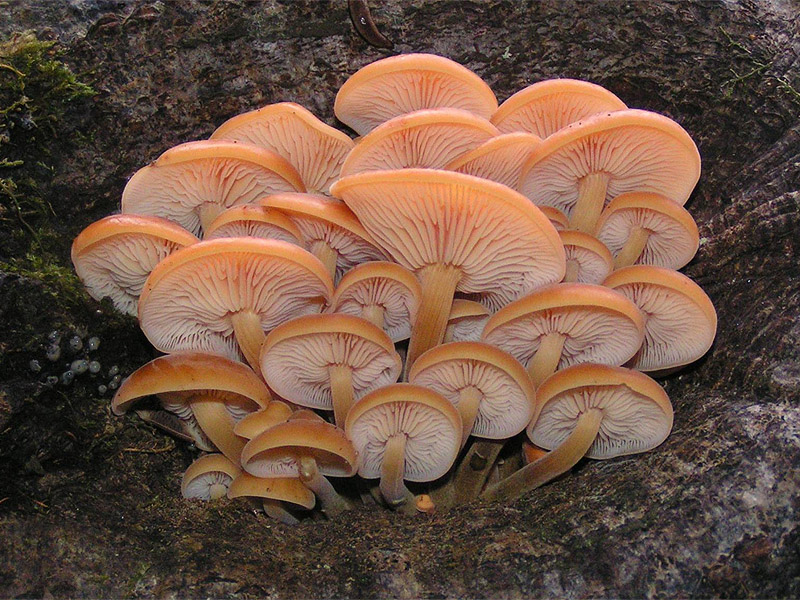
The Velvet Shank is a saprobic or weakly parasitic fungus that primarily appears on dead or weakened deciduous wood during the cold season. It is well-known for its frost resistance, pausing growth during freezing temperatures and resuming when it thaws. Characteristic features include the honey-yellow, slimy cap and the eponymous velvety, dark brown stem. In East Asia, it is cultivated and highly valued under the name Enokitake.
Details
Identification
Cap 2-10 cm, honey-yellow to orange-brown, slimy when moist; gills white to pale yellow; stem tough, yellowish at the top, becoming dark brown to black and velvety towards the base; white spore print.
Diet
Decomposes lignin and cellulose in deciduous wood (white rot pathogen); prefers willow, poplar, ash, and beech.
Overwintering
Production of antifreeze proteins and sugar alcohols that protect cell tissue from ice crystals.
Ecology
Ecological role
Important decomposer in the forest ecosystem; contributes significantly to the nutrient cycle by breaking down deadwood.
Natural predators
Fungus gnat larvae, slugs.
Competitor species
Other wood-decaying fungi such as the Oyster Mushroom (Pleurotus ostreatus).
Ecosystem service
Nutrient cycling (humus formation), providing food for insects during winter.
Threats
Intensive forestry (lack of deadwood).
Scientific profile
Profile
Distinguishing features
Characteristic velvety, dark stem; winter fruiting season (frost resistance due to antifreeze proteins); white spore print; caespitose growth on deciduous wood.
Habitat
Alluvial forests, stream banks, parks, gardens, and forest edges; prefers moist locations with available deciduous wood.
Reproduction
Sexual reproduction via basidiospores; asexual reproduction possible through the formation of oidia (arthrospores) on the mycelium.
Protection & threats
Status not on standard scale
Main threats
Intensive forestry (removal of dead wood), drainage of floodplain sites, and loss of old-growth stands.
Conservation measures
Promotion of dead wood concepts in forestry; protection and restoration of softwood floodplains and moist deciduous mixed forests.