Finned rotifer
Polyarthra
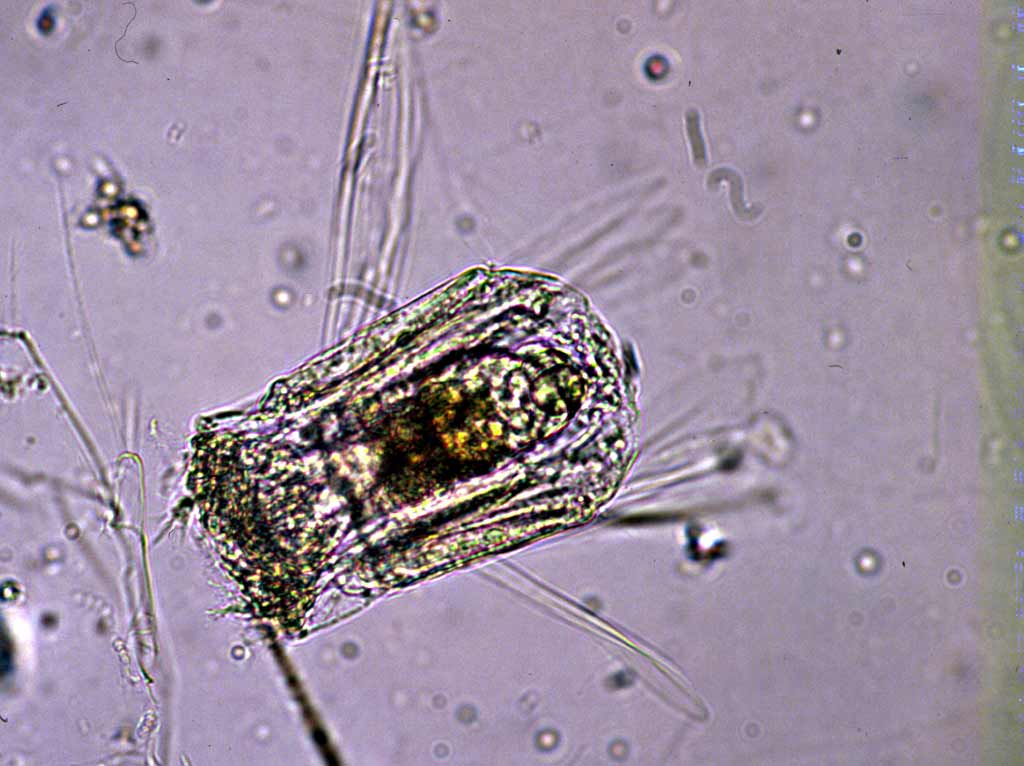
The finned rotifer is a widespread component of limnic zooplankton belonging to the family Synchaetidae. It is characterized by the absence of a foot and the possession of twelve blade-like appendages arranged in four bundles. These 'fins' enable the animal to perform sudden jumping movements to escape predators when threatened. The genus includes several species that often coexist, differing in size and ecological niche.
Details
Identification
Body usually rectangular or sac-shaped; twelve blade- or sword-shaped fins in four groups; foot is absent; virgate-type mastax.
Social behavior
Lives as a solitary individual in the pelagic zone of lakes and ponds.
Diet
Primarily feeds on phytoplankton, with a preference for small flagellates such as Cryptomonas.
Hunting strategy
Filter feeder capturing food particles with the corona; targeted seizing with the mastax.
Spawning substrate
Eggs are either released into the open water or briefly carried on the body.
Overwintering
Formation of thick-walled resting eggs that can survive in the sediment.
Ecology
Ecological role
Important primary consumer and link in the microbial loop, serving as a food source for predatory zooplankton and fish larvae.
Natural predators
Predatory rotifers (e.g., Asplanchna), copepods, cladocerans, and fish larvae.
Competitor species
Other herbivorous zooplankters such as Keratella species or small cladocerans.
Ecosystem service
Contributes to the regulation of algal biomass and nutrient cycling in aquatic ecosystems.
Threats
Eutrophication, chemical pollution (insecticides), and severe acidification of water bodies.
Scientific profile
Profile
Distinguishing features
Possesses 12 lateral appendages (fins) used by powerful muscles for sudden jumping movements (escape response). A foot is entirely absent. The mastax (trophi) is of the virgate type (suction). The genus Polyarthra includes several species distinguished primarily by the shape and length of these fins and the position of nuclei in the vitellaria.
Reproduction
Heterogony: For much of the year, reproduction is asexual through diploid parthenogenesis (amictic females). Under stress conditions, mictic females appear, producing haploid eggs (hatching into males) or, after fertilization, resting eggs.
Role in food web
Central link in the pelagic food web; controls populations of nanophytoplankton (flagellates) and serves as an energy source for higher trophic levels.
Protection & threats
Status not on standard scale
Main threats
Extreme eutrophication leading to oxygen depletion; chemical pollution from pesticides; climate change (warming), which may specifically displace cold-stenothermic species of the genus.