Bog Beacon
Mitrula paludosa
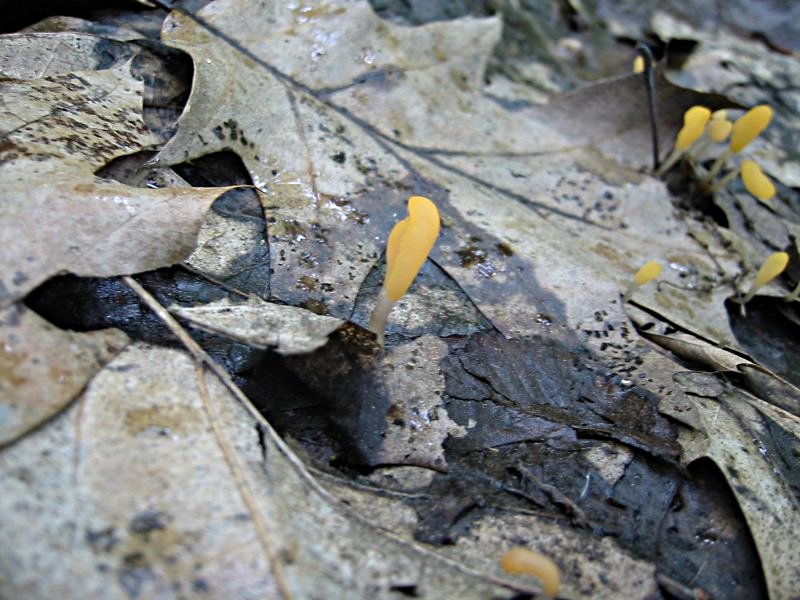
The Bog Beacon is a saprobic fungus known for its vibrant yellow to orange club-shaped fruiting bodies. It typically grows on decaying leaves and needles in acidic, nutrient-poor bog waters, spring seeps, or forest ditches. The fruiting bodies usually appear in spring and early summer, often emerging from shallow water. This species is considered an indicator of clean, cool, and oxygen-rich water environments.
Details
Identification
Bright yellow to orange, smooth head; whitish to translucent stem; growth on submerged organic substrate.
Diet
Saprobic; feeds by decomposing submerged plant material such as leaves (oak, beech) or needles.
Overwintering
Persistence as mycelium within the substrate (decaying leaves or needles).
Ecology
Ecological role
Important primary decomposer in aquatic ecosystems, breaking down organic material for the nutrient cycle.
Natural predators
Water snails and various invertebrate detritivores.
Competitor species
Other water-dwelling fungi and aquatic hyphomycetes.
Ecosystem service
Support of nutrient recycling and self-purification of water bodies through detritus decomposition.
Threats
Drainage of wetlands, eutrophication (nutrient input), and destruction of spring areas.
Scientific profile
Profile
Distinguishing features
Distinct contrast between the bright yellow head and the white stipe; specialized habitat directly in shallow, cold water on decaying leaves or needles.
Habitat
Oligotrophic to mesotrophic, cold and clean waters, spring swamps, ditches in alder fens, bogs, and wet forest depressions.
Reproduction
Sexual reproduction via ascospores (11–19 × 2.5–3 µm) produced in eight-spored asci.
Protection & threats
Status not on standard scale
Main threats
Drainage of bogs and wet forests, eutrophication due to nitrogen input from agriculture, climate change (warming of spring waters).
Conservation measures
Protection and restoration of bog sites, preservation of near-natural spring areas, avoidance of fertilizer input into forest waters (buffer zones).