Testate amoebae
Arcellinida
Testate amoebae are a group of unicellular eukaryotes characterized by the presence of a hard, protective shell (test). This shell is composed of either organic secretions, siliceous plates, or agglutinated foreign particles such as sand grains. They inhabit a wide range of environments worldwide, particularly peatlands, moist soils, and freshwater ecosystems.
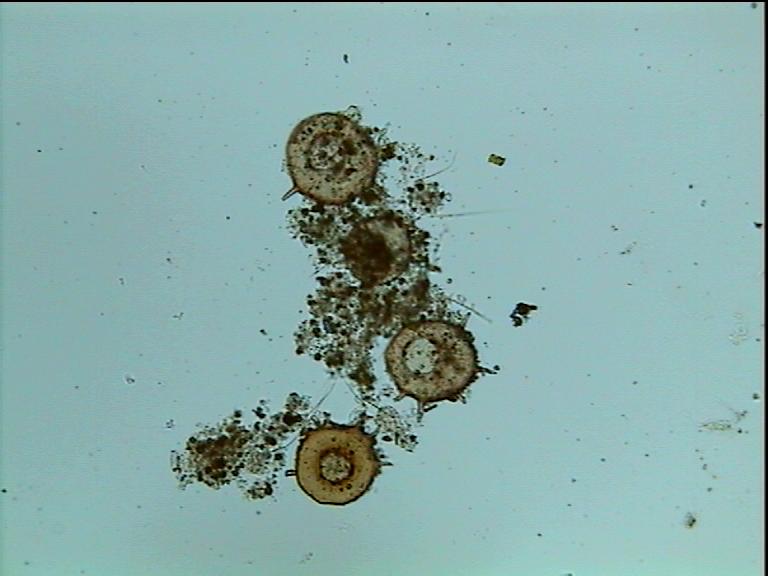
Details
Identification
Presence of a shell with a single opening (aperture); movement via lobose (lobe-shaped) pseudopodia.
Social behavior
Generally solitary; no colony formation.
Diet
Feed on bacteria, algae, fungal spores, and other small protists via phagocytosis.
Hunting strategy
Passive or active engulfing of prey using pseudopodia.
Overwintering
Formation of resting stages (cysts) during unfavorable environmental conditions.
Ecology
Ecological role
Important regulators of microbial populations and key players in the nutrient cycling of peatlands.
Natural predators
Larger protists, rotifers, small crustaceans, and mites.
Competitor species
Other predatory protists and ciliates.
Ecosystem service
Soil formation and nutrient recycling; serve as tools for paleoecological reconstructions.
Threats
Destruction of wetlands, drainage of peatlands, and pesticide input into soils.
Scientific profile
Profile
Habitat
Widely distributed in freshwater ecosystems (littoral zones of lakes, ponds), peatlands (especially in Sphagnum mosses), moist soils, and aquatic sediments. They prefer stable, moist microhabitats.
Reproduction
Asexual reproduction via binary fission. Prior to cell division, a new test is often constructed from secreted material or collected particles, into which part of the protoplast migrates.
Ecological role
Important predators in the microbial food web; they regulate the abundance of bacteria and algae. They serve as a link between the microbial level and higher trophic levels (meiofauna).