Stalked bacterium
Caulobacter crescentus
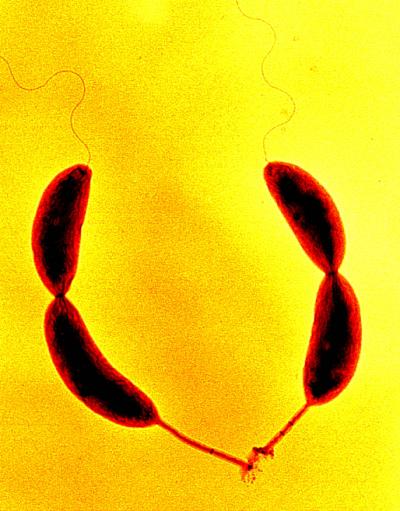
Caulobacter crescentus is a Gram-negative bacterium renowned for its dimorphic life cycle. It alternates between a motile swarmer cell equipped with a flagellum and a sessile stalked cell that attaches to surfaces using a specialized holdfast. The stalk (prostheca) serves both for anchorage and to increase surface area for nutrient uptake in oligotrophic environments. This species is widely used as a model organism in cell biology to study cell cycle regulation and asymmetric cell division.
Details
Identification
Presence of a thin stalk (prostheca) at one cell pole; asymmetric cell division; crescent-shaped cell body.
Social behavior
Forms biofilms by attaching to surfaces and can form rosettes with other cells.
Diet
Oligotrophic; feeds on dissolved organic carbon compounds at very low concentrations.
Overwintering
Persistence through reduced metabolic activity in cold waters.
Ecology
Ecological role
Important component of the microbial food web in nutrient-poor freshwater systems; decomposes organic matter.
Natural predators
Protozoa (protists), bacteriophages.
Competitor species
Other oligotrophic bacterial species in freshwater habitats.
Ecosystem service
Nutrient recycling and mineralization of organic substances in aquatic ecosystems.
Threats
Eutrophication of water bodies, as the species is specialized for oligotrophic (nutrient-poor) conditions.
Scientific profile
Profile
Habitat
Freshwater habitats, particularly oligotrophic lakes, rivers, and streams. It is frequently found in biofilms on submerged surfaces or within drinking water systems, where its nutrient efficiency provides a competitive advantage.
Ecological role
Key component of microbial communities in nutrient-poor waters. It serves as a primary model organism in molecular biology for studying cell cycle regulation, asymmetric division, and cell differentiation. Ecologically, it contributes to the microbial degradation of organic matter.