Grey Willow
Salix cinerea
The Grey Willow is a deciduous shrub or small tree, typically reaching heights of 2 to 6 meters, characterized by grey-felted young twigs and leaf undersides. It thrives in wet, base-rich, but nutrient-poor soils such as bogs, marshes, and riparian zones. As a dioecious species, it produces distinctive catkins in early spring before the leaves emerge. It serves as an important pioneer species and soil stabilizer in wetland ecosystems.
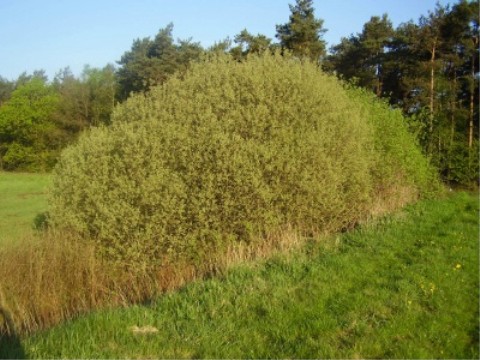
Details
Oxygen production
Produces oxygen through photosynthesis during the growing season.
Habitat function
Nesting site for birds, larval habitat for butterflies, shelter for amphibians near shorelines.
Nutrient uptake
Absorbs nutrients such as nitrogen and phosphorus from water-saturated soils.
Food source for
Honeybees, wild bees, larvae of the eyed hawk-moth, various beetles.
Human use
Occasionally used for basketry, extraction of salicin (medicine), formerly used for charcoal production.
Ecology
Ecological role
Important pioneer species for the initial colonization of wet sites; provides habitat and food for numerous insects.
Natural predators
Various beetle larvae, caterpillar species, and browsing by deer.
Competitor species
Other willow species (Salix spp.), alders (Alnus spp.) in later successional stages.
Ecosystem service
Bank stabilization, erosion control, early pollen source for pollinators (bee pasture).
Threats
Drainage of wetlands, river channelization, loss of peatlands.