Diving bell spider
Argyroneta aquatica
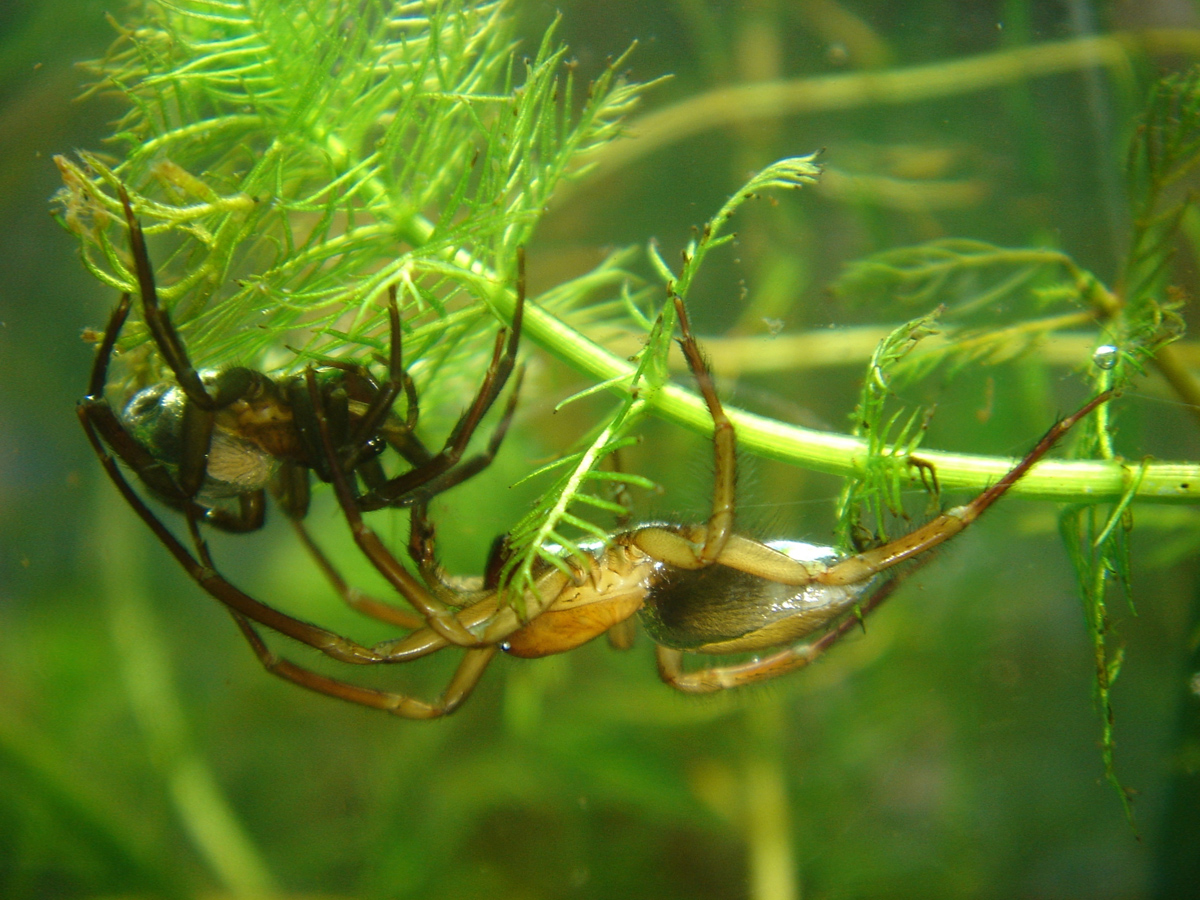
The diving bell spider is the only spider species known to live almost entirely underwater. It constructs a web structure resembling a diving bell, which it fills with air to breathe, eat, and reproduce. Its body is covered by a silvery film of air held in place by fine hairs on the body surface. The species is primarily found in clean, stagnant, or slow-moving, vegetation-rich waters.
Details
Identification
Silvery sheen underwater (physical gill), brown-grey body, densely hairy abdomen.
Social behavior
Solitary, but shows a relatively high tolerance towards conspecifics; males and females often live in adjacent bells.
Diet
Small crustaceans such as isopods and amphipods, insect larvae, and occasionally small fish larvae.
Hunting strategy
Waits in or near the diving bell for prey that touches the signal threads of the web.
Spawning substrate
Underwater plants to which the diving bell is attached.
Overwintering
Overwinters in a specially reinforced, air-filled bell or in empty snail shells at the bottom of the water body.
Ecology
Ecological role
Important predator in the aquatic food web, regulating populations of small crustaceans and insect larvae.
Natural predators
Fish, predatory aquatic insects (e.g., diving beetles, dragonfly larvae), and waterfowl.
Competitor species
Other aquatic predatory invertebrates such as backswimmers or diving beetle larvae.
Ecosystem service
Contribution to biodiversity and control of mosquito larvae.
Threats
Habitat loss through drainage of moors, eutrophication of water bodies, and use of pesticides.
Scientific profile
Profile
Distinguishing features
The only spider species that lives almost entirely underwater. It is characterized by the construction of a 'diving bell' made of silk, which is filled with air. Specialized hairs on the body trap a layer of air for respiration. Unusually for spiders, males are often significantly larger and more robust than females.
Habitat
Stagnant or very slow-moving clean waters with abundant submerged vegetation (e.g., ditches, ponds, fens, oxbow lakes). Prefers mesotrophic to eutrophic but unpolluted habitats.
Role in food web
Secondary or tertiary consumer; regulates populations of aquatic invertebrates; serves as prey for fish and larger aquatic insects.
Protection & threats
Status not on standard scale
Main threats
Destruction of wetlands, drainage, eutrophication due to fertilizer runoff, pesticide use, and loss of aquatic macrophyte vegetation. Red-listed in several European countries (e.g., Category 3 in Germany).
Population trend
Declining in many parts of Central Europe due to habitat fragmentation and deterioration of water quality.