Jelly Ear
Auricularia auricula-judae
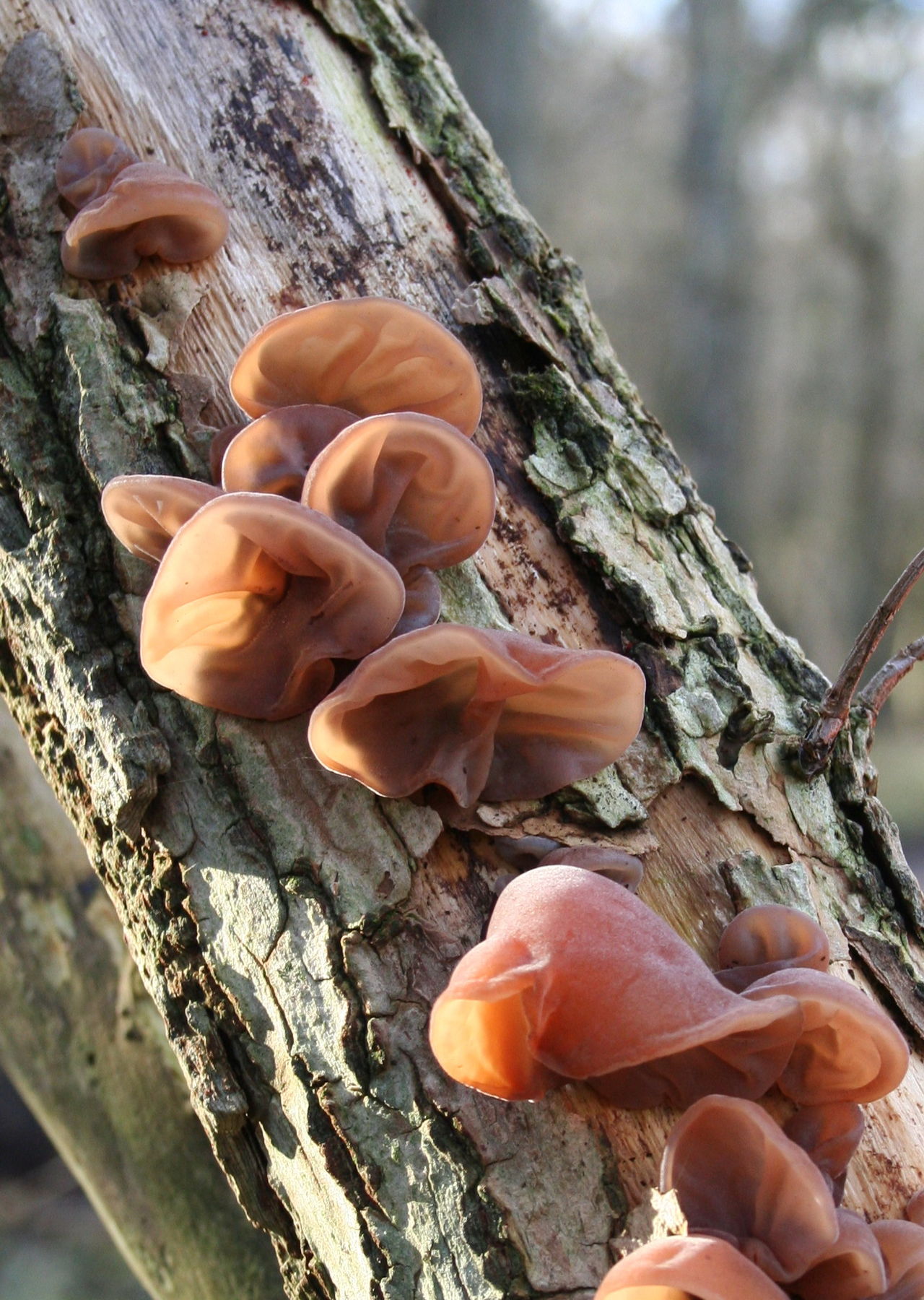
The Jelly Ear is a widely distributed, gelatinous fungus belonging to the Auriculariaceae family. It is characterized by its distinct ear-like shape and reddish-brown color, often appearing translucent when moist. This fungus typically grows as a saprotroph or weak parasite on dead or dying branches of broadleaf trees, most notably elder. It is frost-resistant and its fruiting bodies can be found throughout the year.
Details
Identification
Ear-shaped convoluted fruiting bodies, gelatinous but tough texture, finely velvety outer surface, smooth and shiny inner surface, color ranging from reddish-brown to olive-grey.
Diet
Feeds saprotrophically by decomposing lignin and cellulose in wood, causing white rot.
Spawning substrate
Dead wood of broadleaf trees, preferably elder (Sambucus nigra), less commonly beech, maple, or elm.
Overwintering
Frost-resistant; the fruiting bodies can freeze during winter and continue growing and producing spores when temperatures rise above freezing.
Ecology
Ecological role
Important wood decomposer in the ecosystem; contributes to humus formation and the nutrient cycle.
Natural predators
Insect larvae (e.g., fungus gnats), slugs.
Competitor species
Other wood-decaying fungal species such as the Turkey Tail.
Ecosystem service
Nutrient recycling and decomposition of organic matter in deciduous forests and shrublands.
Threats
Excessive removal of dead wood in managed forest areas.
Scientific profile
Profile
Distinguishing features
Characteristic ear shape, gelatinous consistency, frost resistance (can freeze and thaw), and strong preference for Elder (Sambucus nigra). Microscopically characterized by transversely septate basidia (phragmobasidia).
Habitat
Alluvial forests, moist deciduous mixed forests, hedgerows, parks, and gardens; prefers locations with high humidity.
Reproduction
Sexual reproduction via basidiospores formed on cylindrical, triple transversely septate basidia.
Protection & threats
Main threats
Currently not threatened in Central Europe. Potential threats include the removal of dead wood and the clearing of elderberry thickets in agricultural landscapes.
Conservation measures
Preservation of dead wood structures and promotion of semi-natural forest edges and hedgerows with Sambucus presence.