Common Cyclops
Cyclops strenuus
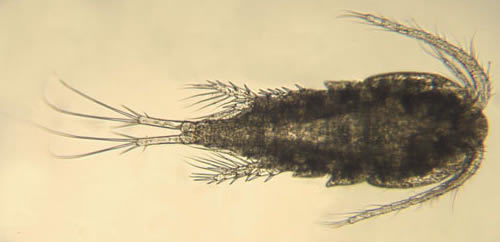
The Common Cyclops is a small copepod widely distributed in various inland waters such as ponds, lakes, and ditches. It is characterized by a pear-shaped body, a single median eye, and long first antennae used for jerky swimming movements. The species is a vital component of freshwater zooplankton and plays a central role in the aquatic food web. Females are easily identified by the characteristic pair of egg sacs attached to their abdomen.
Details
Identification
Single red naupliar eye, 17-segmented first antennae, pear-shaped cephalothorax, forked furca at the end of the body.
Social behavior
Solitary, but often forms dense aggregations in planktonic swarms.
Diet
Omnivorous; feeds on phytoplankton, detritus, protozoa, and occasionally small metazoans such as rotifers.
Hunting strategy
Uses sensory hairs to detect water movements and actively seizes prey with its mouthparts.
Overwintering
Often overwinters in a diapause stage (copepodid) within the sediment or remains active in ice-free waters.
Ecology
Ecological role
Central link in the food web between primary producers and higher-order consumers such as fish.
Natural predators
Juvenile fish, predatory zooplankton, dragonfly larvae, and water bugs.
Competitor species
Other copepod species and cladocerans (water fleas) with similar dietary niches.
Ecosystem service
Contributes to the regulation of phytoplankton populations and nutrient cycling within the water column.
Threats
Eutrophication, pollutant input, and invasive species that alter the food web structure.
Scientific profile
Profile
Distinguishing features
First antennae (A1) consist of 17 segments, reaching the posterior margin of the second thoracic segment. Furcal rami are elongated (approx. 4-6 times as long as wide). The 5th leg (P5) has a characteristic two-segmented structure, with the distal segment bearing a terminal spine and a seta. Females carry two lateral egg sacs.
Reproduction
Exclusively sexual reproduction. After mating, females carry two egg sacs on the abdomen, from which nauplius larvae hatch.
Role in food web
Intermediate consumer; links primary production (via algae consumption) and the level of primary consumers (rotifers) with higher trophic levels (fish).
Protection & threats
Status not on standard scale
Main threats
General threats include massive over-fertilization (hypertrophication), toxic pollutant inputs, and invasive species that alter the food web; however, not globally threatened.