Amoeba
Amoeba proteus
The amoeba is a well-known single-celled organism primarily found in nutrient-rich stagnant waters. It is characterized by its ability to constantly change its body shape through the formation of pseudopodia (false feet). These extensions serve both for locomotion and for capturing prey through phagocytosis. Inside the cell, there is a nucleus, contractile vacuoles for osmoregulation, and food vacuoles.
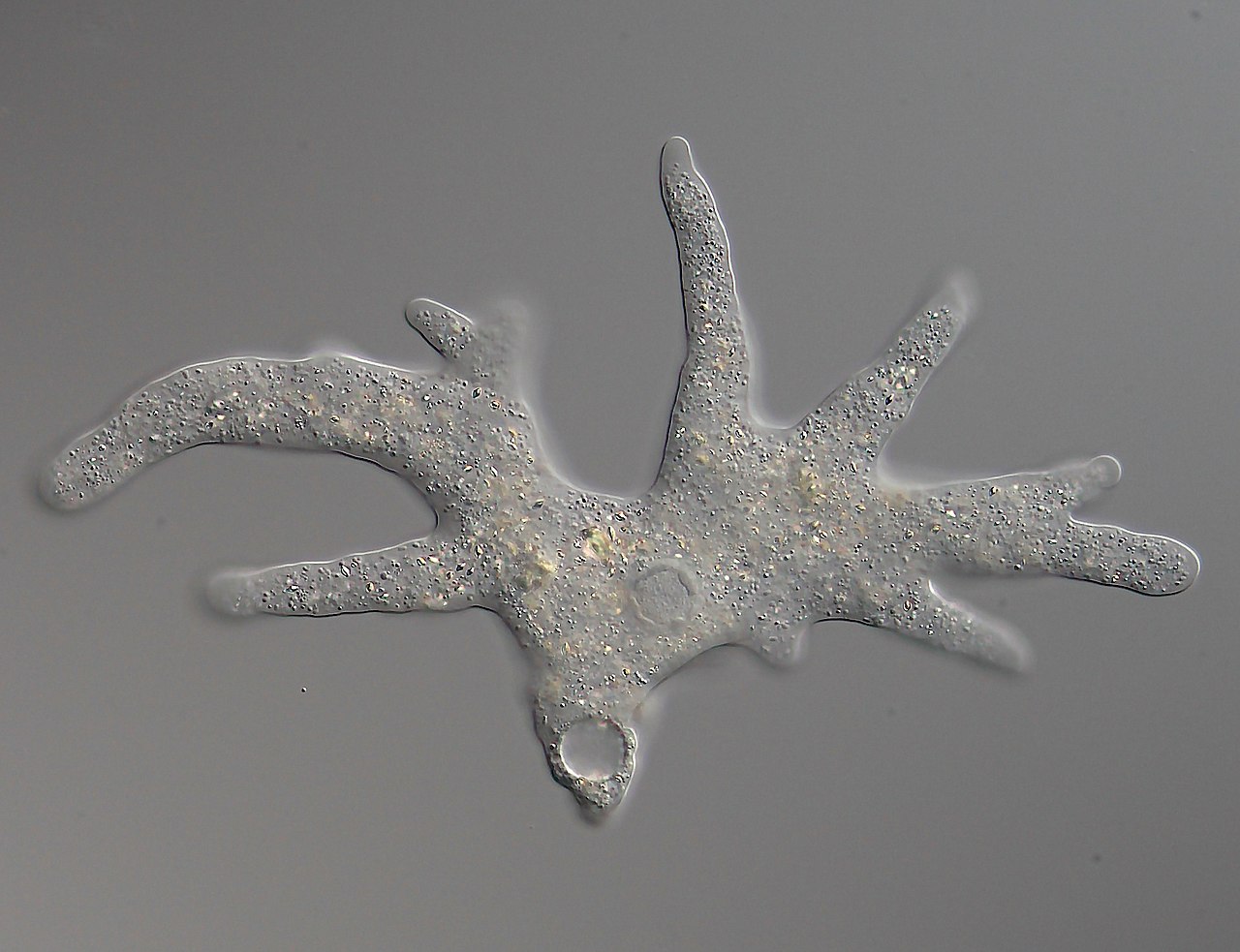
Details
Identification
Constantly changing shape, formation of lobose pseudopodia, visible nucleus and contractile vacuole under a microscope.
Social behavior
Solitary; shows no social interactions except during asexual reproduction.
Diet
Feeds on bacteria, algae, flagellates, and other protozoa.
Hunting strategy
Phagocytosis: The prey is surrounded by pseudopodia and enclosed in a food vacuole.
Overwintering
Formation of cysts (resting stages) during unfavorable environmental conditions or cold.
Ecology
Ecological role
Important consumer in the microbial food web; regulates bacterial populations in aquatic sediments.
Natural predators
Larger protozoa (e.g., predatory ciliates), small crustaceans, and rotifers.
Competitor species
Other heterotrophic protozoa such as Paramecium.
Ecosystem service
Nutrient recycling through the degradation of organic matter and bacterial control.
Threats
Severe chemical water pollution and extreme desiccation of small water bodies.
Scientific profile
Profile
Habitat
Freshwater habitats, especially stagnant or slow-moving waters (ponds, pools, ditches); often found benthically on decaying organic matter (detritus) or aquatic plants.
Reproduction
Asexual by binary fission (mitosis); under unfavorable conditions, some Amoebozoa can form cysts, though this is controversially discussed in literature specifically for Amoeba proteus.
Ecological role
Important predator in the microbial food web; regulates the abundance of bacteria and smaller protists and serves as a link to higher trophic levels.