Marsh Frog
Pelophylax ridibundus
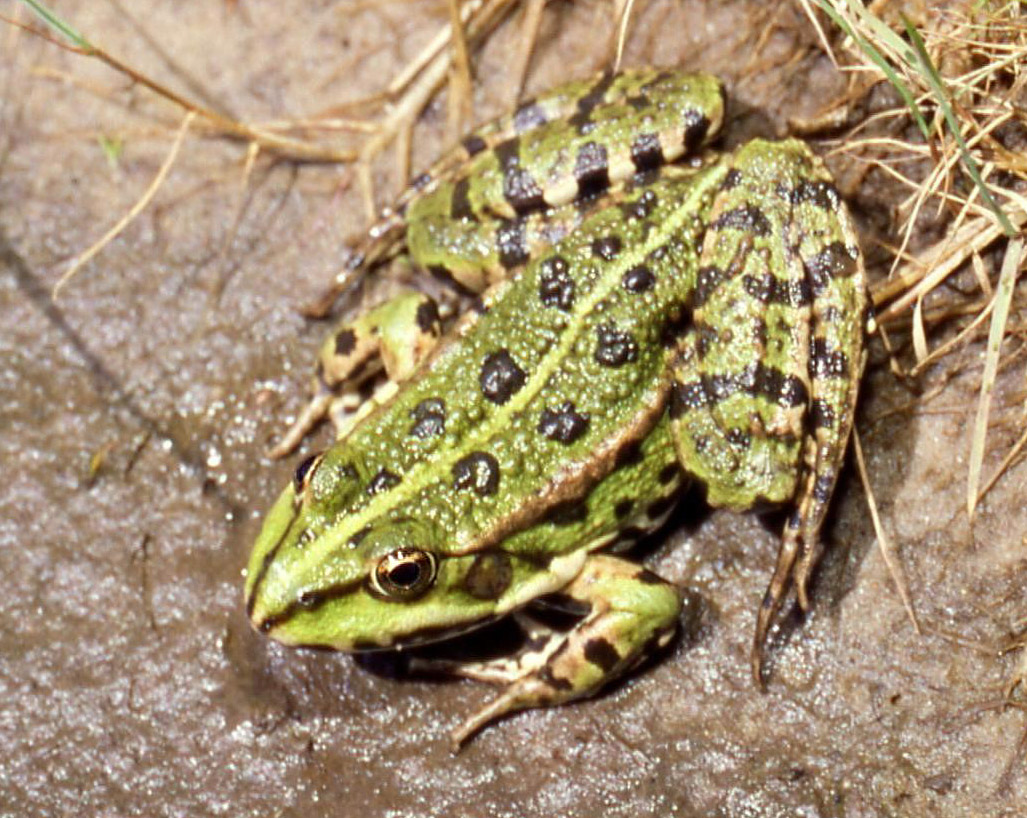
The Marsh Frog is the largest water frog species native to Central Europe, reaching a body length of up to 17 centimeters. It prefers large, sunny standing waters with abundant vegetation as well as slow-moving rivers. Coloration typically ranges from olive-green to brownish with dark spots, often featuring a light green vertebral stripe. A distinctive feature is the loud, laugh-like mating call produced by males, which can be heard from a distance during the breeding season in late spring.
Details
Identification
Very large; metatarsal tubercle small and flat; very long hind legs; vocal sacs of males dark grey; distinctive laughing calls.
Social behavior
Gregarious, living in colonies; males defend calling territories against competitors during the mating season.
Diet
Generalist; feeds on insects, spiders, and worms, but also small vertebrates such as juvenile fish, other amphibians, or mice.
Hunting strategy
Ambush predator that catches prey by direct snapping or with its sticky tongue.
Spawning substrate
Submerged aquatic plants where the spawn clumps are attached.
Overwintering
Usually overwinters aquatically in the mud at the bottom of frost-free water bodies.
Ecology
Ecological role
Important predator of invertebrates and a significant food source for larger birds and predatory fish.
Natural predators
Herons, storks, pike, grass snakes, and various carnivorous mammals such as the Eurasian otter.
Competitor species
Other water frog species and the invasive Bullfrog.
Ecosystem service
Regulation of insect populations and nutrient transfer between aquatic and terrestrial habitats.
Threats
Loss of wetlands, water pollution by pesticides, and the spread of chytrid fungus infection.
Scientific profile
Profile
Distinguishing features
Largest native anuran; metatarsal tubercle is small, flat, and triangular; male vocal sacs are dark gray to blackish; calls sound like staccato laughter.
Role in food web
Important predator for insects and small vertebrates; simultaneously a significant prey item for birds, fish, and grass snakes.
Protection & threats
Main threats
Destruction of riparian vegetation, water engineering, intensive fisheries, pesticide input, invasive species (e.g., bullfrog), and climate change (drying out of breeding sites).
Population trend
Stable to slightly declining in intensively used agricultural landscapes; however, still widespread and common in many regions of Central Europe.
Conservation measures
Preservation and restoration of near-natural riparian zones, protection of large standing waters from eutrophication, creation of buffer zones to agriculture, reduction of fish stocking in breeding waters.