Grass Carp
Ctenopharyngodon idella
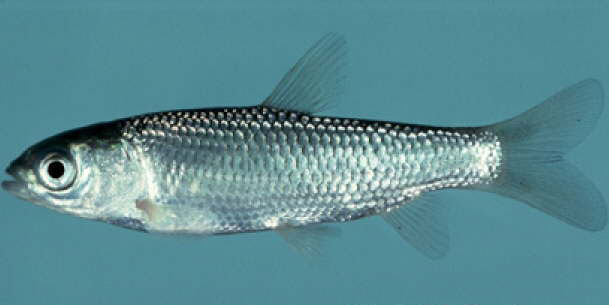
The grass carp is a large freshwater fish with a torpedo-shaped body and characteristically large scales. Originally native to the large river systems of East Asia, it has been introduced worldwide for the biological control of aquatic vegetation. As an adult, it feeds almost exclusively on macrophytes and can consume daily amounts equivalent to its own body weight.
Details
Identification
No barbels, very large scales with dark edges (reticulated pattern), broad head with terminal to slightly subterminal mouth, short dorsal fin base.
Social behavior
Juveniles live in large schools; adults are gregarious but form smaller groups or may become more solitary if food is scarce.
Diet
Juveniles feed on zooplankton and small insect larvae; from a length of approx. 10 cm, they transition to an almost purely plant-based diet (macrophytes, algae).
Hunting strategy
Non-predatory; actively grazes on submerged vegetation and also consumes overhanging grasses at high temperatures.
Spawning substrate
Pelagic; eggs are released into open water and require strong currents to remain buoyant.
Overwintering
Overwintering in deep, slow-moving water areas with significantly reduced metabolism.
Ecology
Ecological role
Primary consumer; can massively alter water body structure through overgrazing and destroy habitat for other species.
Natural predators
Pike, catfish, and cormorant (for juveniles); adult fish have few natural predators due to their size.
Competitor species
Other herbivorous fish as well as waterfowl (e.g., coots) when foraging.
Ecosystem service
Regulation of mass developments of aquatic plants in commercial harbors or canals.
Threats
In its native range, habitat loss due to river engineering; globally threatened by overfishing of natural populations.
Scientific profile
Morphology & ID
Coloration
Back dark olive to brownish; sides lighter with a golden or silvery sheen; belly whitish. Large scales have dark margins, creating a net-like pattern.
Distinguishing features
No barbels present; terminal mouth; very broad forehead; lateral line scale count 34-45; pharyngeal teeth in two rows and serrated.
Confusion species
Chub (Squalius cephalus - has larger anal fin), Black Carp (Mylopharyngodon piceus - darker, different pharyngeal teeth), Common Carp (Cyprinus carpio - possesses barbels).
Sexual dimorphism
Males develop fine breeding tubercles on the inner surfaces of the pectoral fins during the spawning season.
Habitat
Fish region
Bream region (Potamon) as well as lentic waters (lakes, ponds).
Preferred zone
Near-shore areas (littoral) with abundant macrophyte growth.
Flow preference
Prefers standing waters or very slow-moving sections of large rivers.
Substrate preference
Muddy or sandy substrate with dense submerged aquatic vegetation.
Oxygen requirement
Low; can briefly tolerate very low oxygen concentrations (down to approx. 2 mg/L).
Migration
Migration behaviour
Migrates to the upper reaches of large rivers with strong currents for reproduction; requires turbulent water for egg development.
Reproduction
Spawning substrate
Pelagic; eggs are released into the open water and drift with the current.
Larval phase
Larvae hatch after approx. 30-40 hours, drift into calm zones, and initially feed on zooplankton.
Parental care
No parental care.
Diet
Feeding type
Herbivorous (plant-eater).
Diet juvenile
Zooplankton, small invertebrates (e.g., chironomid larvae).
Diet adult
Higher aquatic plants (macrophytes), algae, and overhanging terrestrial plants.
Feeding strategy
Active grazing on vegetation; can consume amounts up to its own body weight daily at high temperatures.
Schooling
Gregarious; forms schools especially during juvenile stages, often in smaller groups when older.
Ecological role
Role in food web
Primary consumer; can significantly influence water structure and nutrient dynamics through massive grazing (ecosystem engineer).
Natural predators
Pike, Wels catfish, Zander, and piscivorous birds (e.g., cormorant) for juveniles; adults have few natural predators.
Competitor species
Competition for habitat with native cyprinids; food competition with other herbivorous species (rare in Europe).
Parasites
Bothriocephalus acheilognathi (Asian tapeworm), various trematodes and ectoparasites.
Bioindicator function
Indicator for anthropogenically influenced, eutrophic waters (often due to stocking for algae control).
Fisheries & legal
Fishing regulation
Often a stocked fish in Germany; in some federal states, stocking is prohibited or removal is mandatory due to invasive potential.
Closed season
Usually no statutory closed season, as it is a non-native species.
Economic use
Important food fish in global aquaculture (especially China); biological weed control of industrial waterways.
Protection & threats
Status not on standard scale
Main threats
Threatened in its native range by overfishing and damming; in Europe, as a neozoon, it is rather a threat to native ecosystems.
Population trend
Stable to increasing due to global introduction and stocking measures.
Conservation measures
No conservation measures in Europe; management often aims at limiting its spread.