Western Clubtail
Gomphus pulchellus
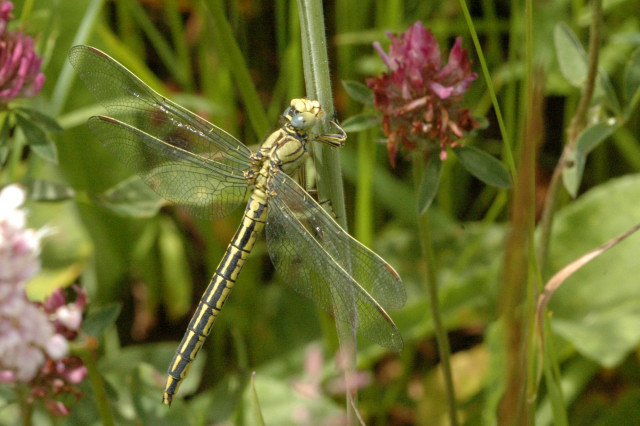
The Western Clubtail is a medium-sized dragonfly belonging to the Gomphidae family, reaching a length of approximately 5 cm. It is characterized by its yellow and black pattern and widely separated eyes. Unlike many other clubtails, it prefers stagnant or very slow-moving waters with sandy or silty substrates. Its primary distribution is in Western Europe, though it has been expanding its range towards the northeast in recent decades.
Details
Identification
Yellow base color with fine black lines; legs predominantly yellow with black longitudinal stripes; eyes clearly separated; male abdomen only slightly club-shaped at the tip.
Social behavior
Solitary; males occupy temporary territories on sunny shoreline sections during the mating season.
Diet
Larvae are predatory, feeding on aquatic insects, small crustaceans, and worms. Adults hunt various flying insects.
Hunting strategy
Larvae are ambush predators in the sediment; adults are perch hunters that catch prey insects in flight from a lookout point.
Spawning substrate
Eggs are deposited on the water surface during flight by briefly dipping the abdomen and then sink into the sandy bottom.
Overwintering
Overwintering as larvae within the aquatic substrate (usually a two- to three-year larval development period).
Ecology
Ecological role
Important predator in both aquatic and terrestrial ecosystems; serves as a food source for birds and fish.
Natural predators
Birds (e.g., Eurasian Hobby), larger dragonfly species, frogs; larvae are eaten by fish and aquatic beetles.
Competitor species
Other Gomphid species and large dragonflies with similar habitat requirements.
Ecosystem service
Regulation of insect populations (e.g., mosquitoes).
Threats
Destruction of shoreline habitats, eutrophication of water bodies, intensive fish farming, and stabilization of natural sandy banks.
Scientific profile
Profile
Distinguishing features
Narrow black thoracic lines (narrower than the yellow gaps); continuous yellow dorsal stripe on abdominal segments 8 and 9; abdomen tip hardly club-shaped (untypical for the family); yellow-striped legs (distinction from G. vulgatissimus).
Role in food web
Important predator in macrozoobenthos (larvae) and consumer of flying insects (adults); serves as prey for fish and birds.
Protection & threats
Main threats
Eutrophication of water bodies, destruction of riparian habitats, intensive fishery use (rooting activity of carp), wave action from boat traffic.
Population trend
Stable to increasing; the species is currently expanding northeastwards (e.g., Lower Saxony, Czech Republic) due to climate change.
Conservation measures
Protection and maintenance of secondary habitats such as gravel pits; promotion of near-natural shore structures; avoidance of overstocking with benthivorous fish.