Woodland Wolf Spider
Pardosa lugubris
The Woodland Wolf Spider (specifically the Pardosa lugubris species complex) is a widespread spider of the European ground fauna. It prefers sunny forest edges, clearings, and adjacent meadows with sparse vegetation. It is characterized by fast running behavior on the ground surface during sunshine, locating its prey visually. The species often forms very high population densities in suitable habitats and is an important component of the ecosystem.
Details
Identification
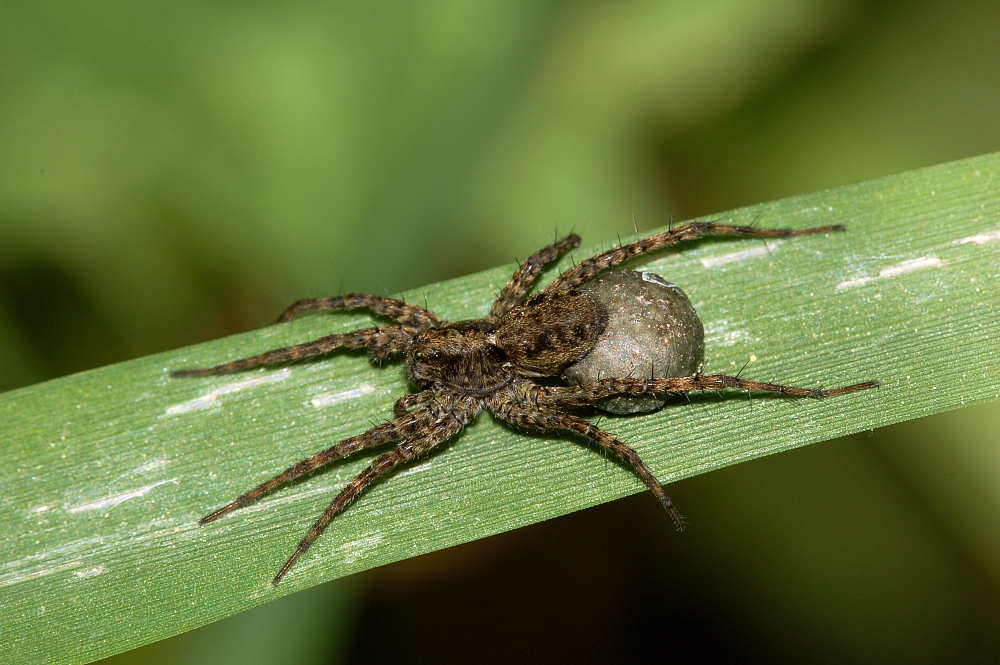
Dark brown prosoma with a light median stripe; males are darker and often have white-haired tarsi; females carry a bluish-grey egg sac.
Social behavior
Solitary and cannibalistic; interactions are limited to mating and brood care by the female.
Diet
Small invertebrates, especially springtails (Collembola), aphids, small flies, and other spiders.
Hunting strategy
Active visual hunting on the ground; prey is pursued without a web and overwhelmed in a jump.
Spawning substrate
Egg sac is carried on the spinnerets and not deposited on a substrate.
Overwintering
Overwintering as subadults in leaf litter, under dead wood, or in moss cushions.
Ecology
Ecological role
Important predator in the leaf litter, contributing to the regulation of insect populations.
Natural predators
Insectivorous birds, small reptiles (e.g., viviparous lizards), shrews, and spider wasps.
Competitor species
Other wolf spider species of the genus Pardosa and predatory ground beetles.
Ecosystem service
Biological pest control through the consumption of herbivorous insects.
Threats
Habitat loss due to intensive forestry, sealing of forest edges, and excessive use of pesticides.
Scientific profile
Profile
Distinguishing features
Pardosa lugubris belongs to a cryptic species complex (P. lugubris s. l.). Males are characterized by a deep black base color and white hairs on the tarsi of the pedipalps. Reliable differentiation from sibling species like P. saltans often requires microscopic examination of genital structures (palpal bulb in males, epigyne in females).
Habitat
Prefers sunny deciduous forest edges, clearings, clear-cuts, and hedgerow structures. Also found in near-natural gardens and parks with a leaf litter layer (hence the name garden wolf spider).
Role in food web
Important predator in the litter layer, regulating populations of small insects. Serves as food for birds, lizards, shrews, and predatory insects such as spider wasps.
Protection & threats
Main threats
Loss of ecotones and forest edge structures due to intensive forestry; sealing of garden areas and removal of leaf litter.
Population trend
Stable; the species is widespread and common in Central Europe.