Common water flea
Daphnia pulex
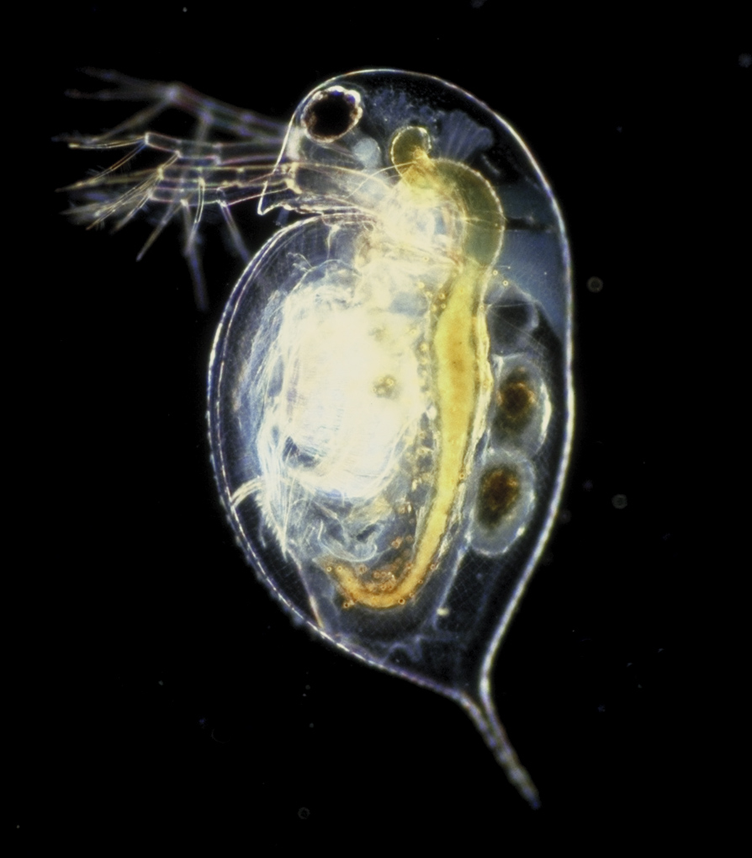
Daphnia pulex is a widespread freshwater microcrustacean known for its characteristic jerky, hopping swimming motion enabled by large second antennae. It features a nearly transparent carapace that covers the body but leaves the head exposed. As a primary consumer, it plays a fundamental role in aquatic food webs by regulating algal populations and serving as a vital food source for higher trophic levels.
Details
Identification
Transparent carapace, large black compound eye, oar-like second antennae, short apical spine at the end of the body.
Social behavior
Often occurs in extremely high individual densities (swarms) but does not exhibit complex social interactions.
Diet
Filters unicellular algae, bacteria, and organic detritus from the water using specialized thoracic appendages.
Hunting strategy
Passive filter feeder; creates a water current through rhythmic movements of its phyllopods.
Spawning substrate
Eggs are carried in a dorsal brood chamber located under the carapace.
Overwintering
Production of resting eggs (ephippia) that overwinter in the sediment and can withstand extreme environmental conditions.
Ecology
Ecological role
Key transformer of primary production into animal protein; regulates algal growth and improves water clarity.
Natural predators
Juvenile fish, predatory zooplankton (e.g., Chaoborus larvae), backswimmers, dragonfly larvae.
Competitor species
Other Daphnia species (e.g., Daphnia magna), rotifers, filter-feeding copepods.
Ecosystem service
Self-purification of water bodies through algal filtration; foundation of the food chain for fisheries.
Threats
Pesticide input into water bodies, acidification, invasive species, and extreme heatwaves due to climate change.
Scientific profile
Profile
Distinguishing features
Features a prominent apical spine (spina) at the posterior end of the carapace. The primary microscopic diagnostic feature distinguishing it from Daphnia magna is the finer pecten on the postabdominal claw, along with the specific shape of the rostrum and head pores.
Reproduction
Cyclical parthenogenesis: Asexual reproduction (virgin birth) under favorable conditions; environmental stress (food scarcity, cold) triggers the production of males and sexual reproduction.
Role in food web
Central primary consumer and keystone species; controls algal growth through high grazing potential and serves as a major food source for higher trophic levels.
Protection & threats
Status not on standard scale
Main threats
Habitat loss due to the drainage of small water bodies, pesticide runoff from intensive agriculture, and invasive predatory species.