Common dace
Leuciscus leuciscus
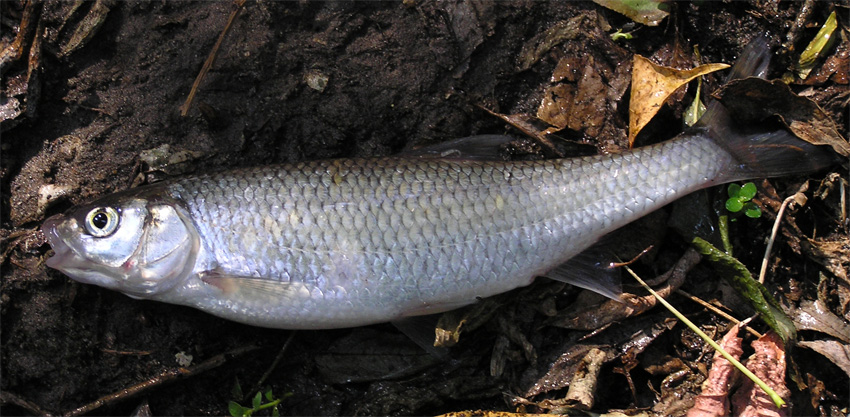
The common dace is a rheophilic freshwater fish with a slender, spindle-shaped body and silvery coloration. It prefers clear, fast-flowing waters of the grayling and barbel zones but can also be found in some lakes. It is characterized by yellowish fins, a slightly subterminal mouth, and a concave anal fin.
Profile
15cm
40cm
0.2kg
12yr
0.2m
4m
4°C
22°C
Details
Identification
Silvery flanks, white belly, anal fin distinctly concave (curved inwards), yellowish iris.
Social behavior
Gregarious schooling fish, usually found in groups within the current or mid-water.
Diet
Omnivore; feeds on insect larvae, small crustaceans, surface insects, and algae.
Hunting strategy
Active foraging on the bottom as well as snapping insects from the water surface.
Spawning substrate
Gravel and stones (lithophilic), rarely aquatic plants.
Overwintering
Retreats to deeper, slow-flowing areas and reduces metabolic activity.
Ecology
Ecological role
Important prey for predatory fish and birds; acts as a host fish for the glochidia of the thick-shelled river mussel (Unio crassus).
Natural predators
Pike, pike-perch, cormorant, kingfisher, otter.
Competitor species
Other cyprinids such as chub and roach.
Ecosystem service
Supports the reproduction of rare mussel species and contributes to the nutrient cycle in the water.
Threats
River engineering, loss of gravel spawning grounds due to siltation, migration barriers (weirs).