Emperor Dragonfly
Anax imperator
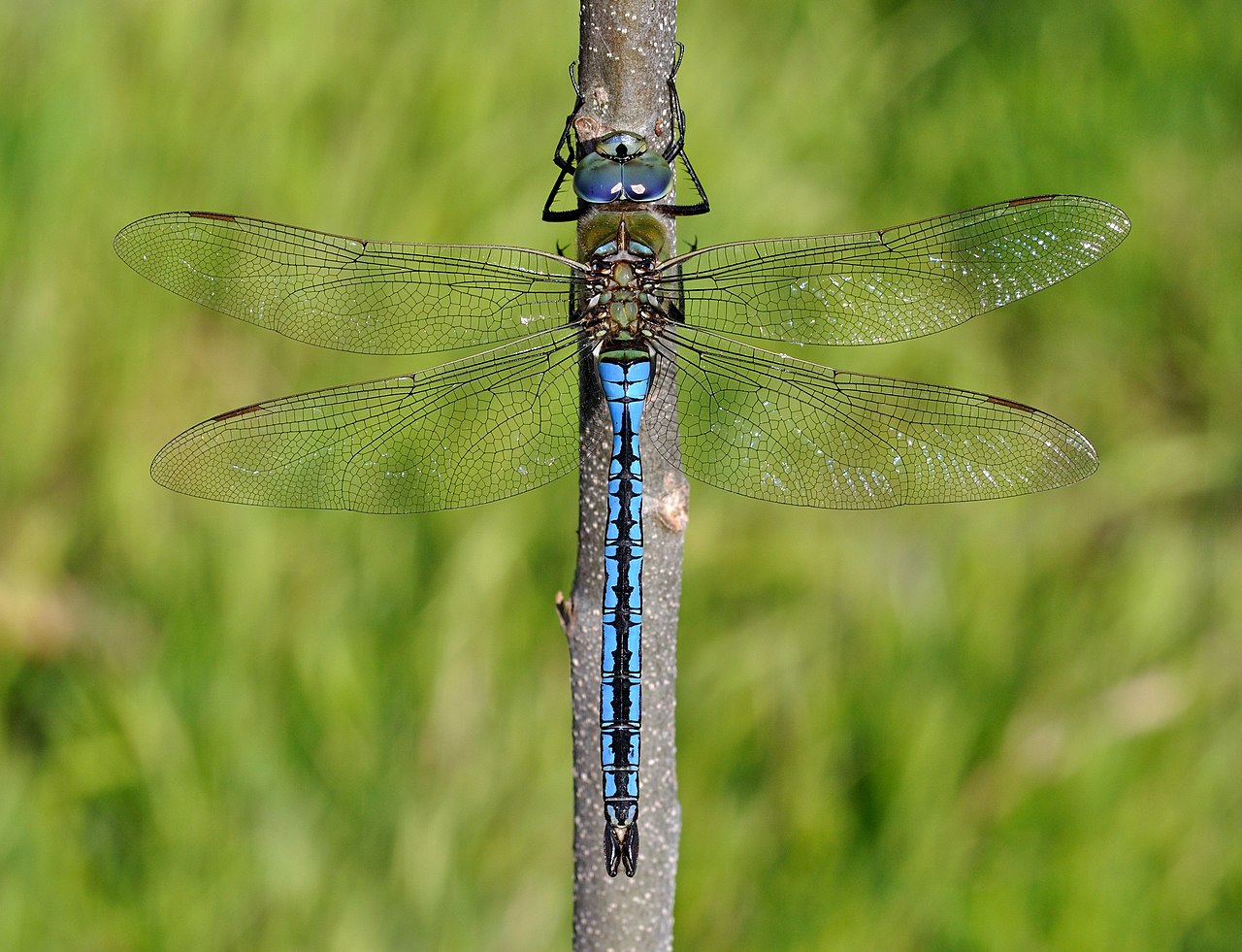
The Emperor Dragonfly is one of the most impressive dragonfly species in Central Europe, primarily inhabiting standing waters. Males are recognizable by their bright blue abdomen and green thorax. As skilled flyers, they spend most of the day in the air hunting other insects.
Details
Identification
Green thorax without black stripes, blue (M) or green (F) abdomen with a black longitudinal stripe, wingspan up to 11 cm.
Social behavior
Males are extremely territorial and aggressively defend their territories against conspecifics and other large dragonflies.
Diet
Predatory; larvae feed on insect larvae, tadpoles, and small fish. Adults hunt flying insects such as flies and mosquitoes.
Hunting strategy
Active hunting flights (adults) and ambush hunting in the water (larvae).
Spawning substrate
Endophytic egg-laying into floating or living aquatic plants such as pondweeds or reeds.
Overwintering
Overwintering occurs in the larval stage at the bottom of the water body.
Ecology
Ecological role
Significant predator in aquatic and terrestrial boundary ecosystems.
Natural predators
Birds (e.g., Hobby), frogs, larger fish (for larvae).
Competitor species
Other large dragonflies such as the Southern Hawker (Aeshna cyanea).
Ecosystem service
Biological pest control by consuming mosquitoes and flies.
Threats
Loss of small water bodies, intensive agriculture, and pesticide runoff.
Scientific profile
Profile
Distinguishing features
Largest native dragonfly species; sides of the thorax uniform green without black stripes; males with downward-curved superior anal appendages; eyes meet over a long distance on top of the head.
Role in food web
Top predator among aquatic insects and an important aerial hunter.
Protection & threats
Main threats
Destruction of riparian vegetation, use of pesticides in agriculture, drying up of small water bodies due to climate change.
Population trend
Stable to increasing; the species tends to benefit from global warming and is expanding northwards.
Conservation measures
Preservation and creation of fish-free or low-fish standing waters; protection of reed and floating-leaf zones.