Common Backswimmer
Notonecta glauca
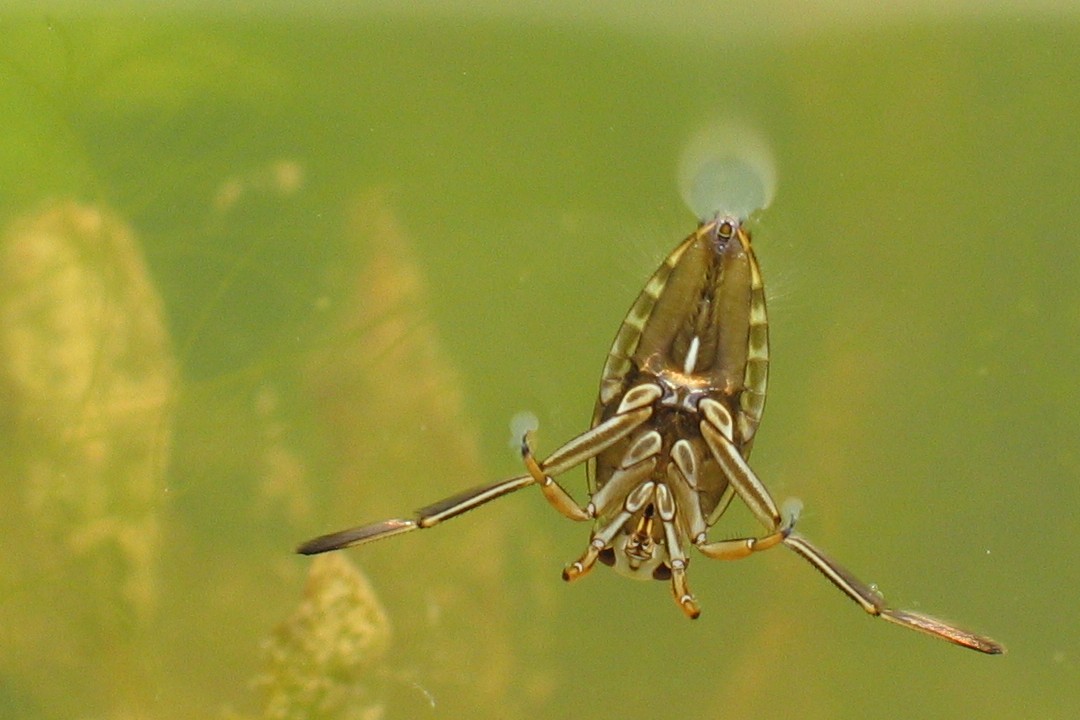
The common backswimmer is an aquatic bug characterized by its habit of swimming upside down on its back. It features a keel-shaped dorsal side and powerful, oar-like hind legs used for rapid propulsion. This species inhabits stagnant or slow-moving water bodies and is known for its painful bite, earning it the nickname water bee.
Details
Identification
Keel-shaped back, oar-like elongated hind legs, silvery air film on the ventral side, swimming in an upside-down position.
Social behavior
Solitary; exhibits aggressive behavior towards prey and occasional cannibalism towards smaller conspecifics.
Diet
Predatory; feeds on insect larvae, small crustaceans, tadpoles, and occasionally small fish fry.
Hunting strategy
Ambush predator that hangs from the water surface or plants and detects vibrations from prey.
Spawning substrate
Aquatic plant tissue, where eggs are inserted using the ovipositor.
Overwintering
Overwinters as an adult in the water, often in mud or hidden within vegetation.
Ecology
Ecological role
Important predator for regulating insect populations, especially mosquito larvae.
Natural predators
Larger fish, waterfowl, predatory beetle larvae (e.g., great diving beetle).
Competitor species
Other backswimmer species (Notonecta spp.), great diving beetles, water striders.
Ecosystem service
Biological pest control by consuming mosquito larvae.
Threats
Destruction of small water bodies, use of insecticides, excessive fish stocking in small ponds.
Scientific profile
Profile
Distinguishing features
Characteristic upside-down swimming position; hind legs modified into long, hairy oar-like structures; strong, short piercing rostrum (beak); body is boat-shaped, elongated, and strongly keeled ventrally.
Role in food web
Important predator in small water bodies; regulates insect populations; serves as food for larger fish and waterfowl.
Protection & threats
Main threats
Loss of small water bodies through infilling or drainage; excessive fish stocking (predation pressure); severe eutrophication and herbicide use destroying macrophytes.
Population trend
Stable; the species is widespread and common (not threatened in Germany according to the Red List).
Conservation measures
Preservation and creation of small water bodies; avoidance of fish stocking in ponds; protection of riparian vegetation; reduction of nutrient input.