Common Tansy
Tanacetum vulgare
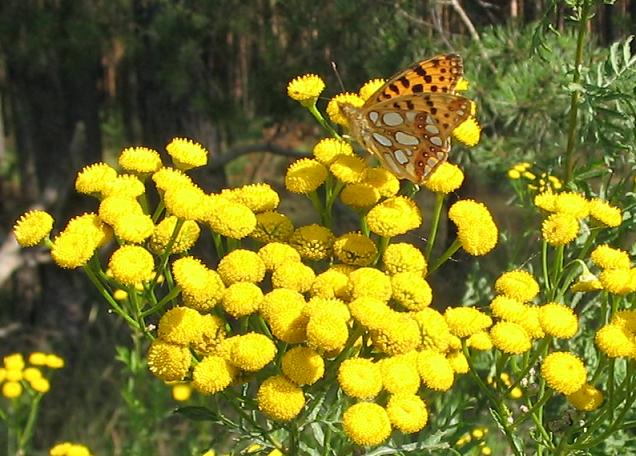
Common Tansy is a perennial herbaceous plant that reaches heights of 60 to 150 centimeters. It is characterized by its golden-yellow, basket-shaped flower heads that lack ray florets, giving them a button-like appearance. The plant emits a strong, camphor-like odor and grows preferentially on roadsides, embankments, and riverbanks.
Details
Habitat function
Habitat and pollen source for wild bees (e.g., Tansy masked bee), hoverflies, and beetles.
Nutrient uptake
Effective uptake of nitrogen from the soil; contributes to the nutrient cycle.
Food source for
Tansy masked bee (Hylaeus nigritus), Tansy leaf beetle, caterpillars of the Tansy Pug and various owlet moths.
Human use
Historically used as a vermifuge (toxic due to thujone), currently used as a dye plant and natural insecticide.
Ecology
Ecological role
Important food source for specialized insects; provides structure in ruderal biotopes and along riparian fringes.
Natural predators
Various insect larvae and specialized leaf beetles such as the Tansy leaf beetle (Galeruca tanaceti).
Competitor species
Competitive tall perennials of the ruderal flora such as Canadian Goldenrod or various grasses.
Ecosystem service
Pollination by insects, erosion control on slopes via rhizome formation, biological pest control (liquid manure).
Threats
Destruction of ruderal areas, excessive mowing of roadsides and riparian zones.
Scientific profile
Profile
Reproduction
Generative via achenes (wind and burr dispersal) and vegetative through rhizome runner formation.
Protection & threats
Main threats
Currently not threatened; local declines due to excessive mowing of roadsides and intensive herbicide use in agriculture.