Vernal Colletes
Colletes cunicularius
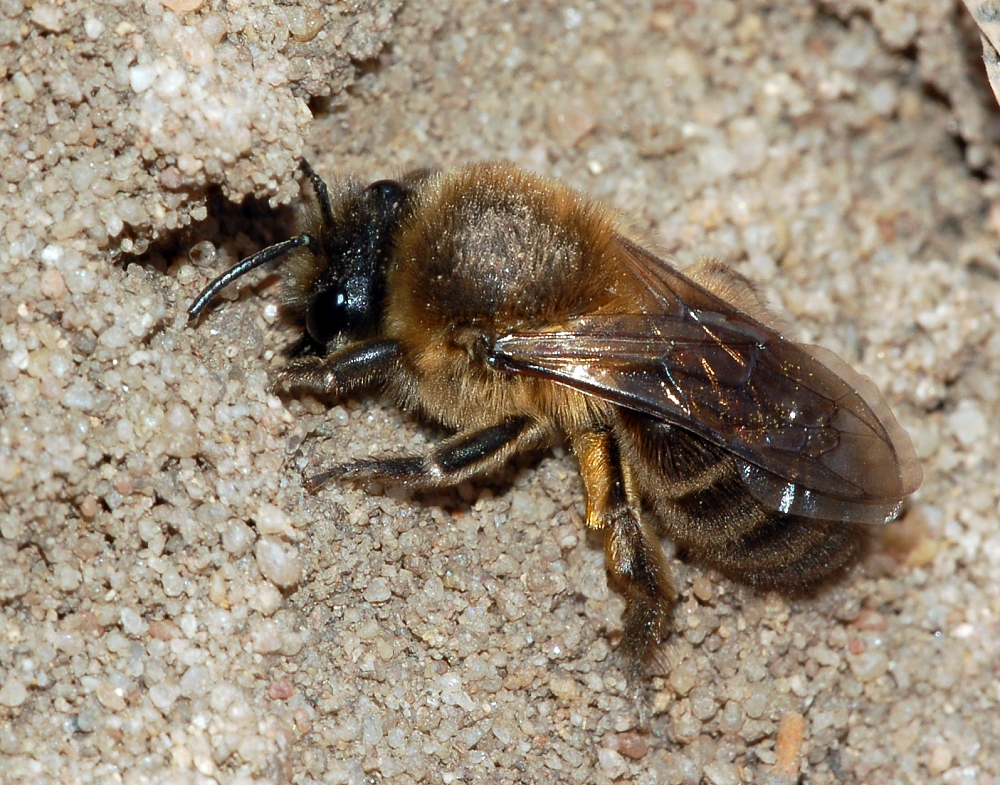
The Vernal Colletes is one of the largest native plasterer bees, reaching nearly the size of a honeybee. It is characterized by dense, brownish-grey hair and is active on sunny days as early as March. The species nests solitarily in self-dug burrows in sandy soil, though it often forms impressive aggregations with thousands of individuals. Being oligolectic, its presence is highly dependent on the availability of flowering willow trees.
Details
Identification
Dense brown hair on the thorax, black abdomen with light hair bands, females with pollen-collecting hairs on the hind legs.
Social behavior
Solitary, but often forms large nesting aggregations (gregarious).
Diet
Oligolectic specialist on willow trees (Salix species) as a pollen source.
Spawning substrate
Sandy soil, often in embankments or flat areas.
Overwintering
Overwinters as a fully developed adult (imago) within the sealed brood cell in the ground.
Ecology
Ecological role
Important pollinator for willow species in early spring; host for specialized cuckoo bees.
Natural predators
Cuckoo bee (Sphecodes albilabris) as a brood parasite, insectivorous birds.
Competitor species
Other early-flying willow specialists such as Andrena vaga.
Ecosystem service
Pollination of wild plants and early-blooming woody plants.
Threats
Loss of sandy habitats due to construction or succession, removal of willow shrubs.
Scientific profile
Profile
Distinguishing features
Largest native species of the genus Colletes. Characteristic is the short, bifid tongue (typical for Colletidae). The species flies very early in the year (March) and is strictly associated with willows (Salix). Unlike mining bees (Andrena), silk bees do not possess facial foveae.
Habitat
Sandy areas, inland dunes, floodplains with dynamic sandbanks, sand and gravel pits, occasionally in sandy gardens or parks.
Protection & threats
Main threats
Loss of dynamics in floodplains (prevention of sandbank formation), backfilling of sand pits, sealing of sandy areas in urban settings, decline of willow populations.
Population trend
Overall stable in Germany, partly benefiting from secondary habitats like extraction sites, but locally threatened by habitat loss.
Conservation measures
Protection and revitalization of floodplains, preservation of sand pits as secondary habitats, promotion of native willow species, maintaining open sandy areas through scrub removal.