Signal crayfish
Pacifastacus leniusculus
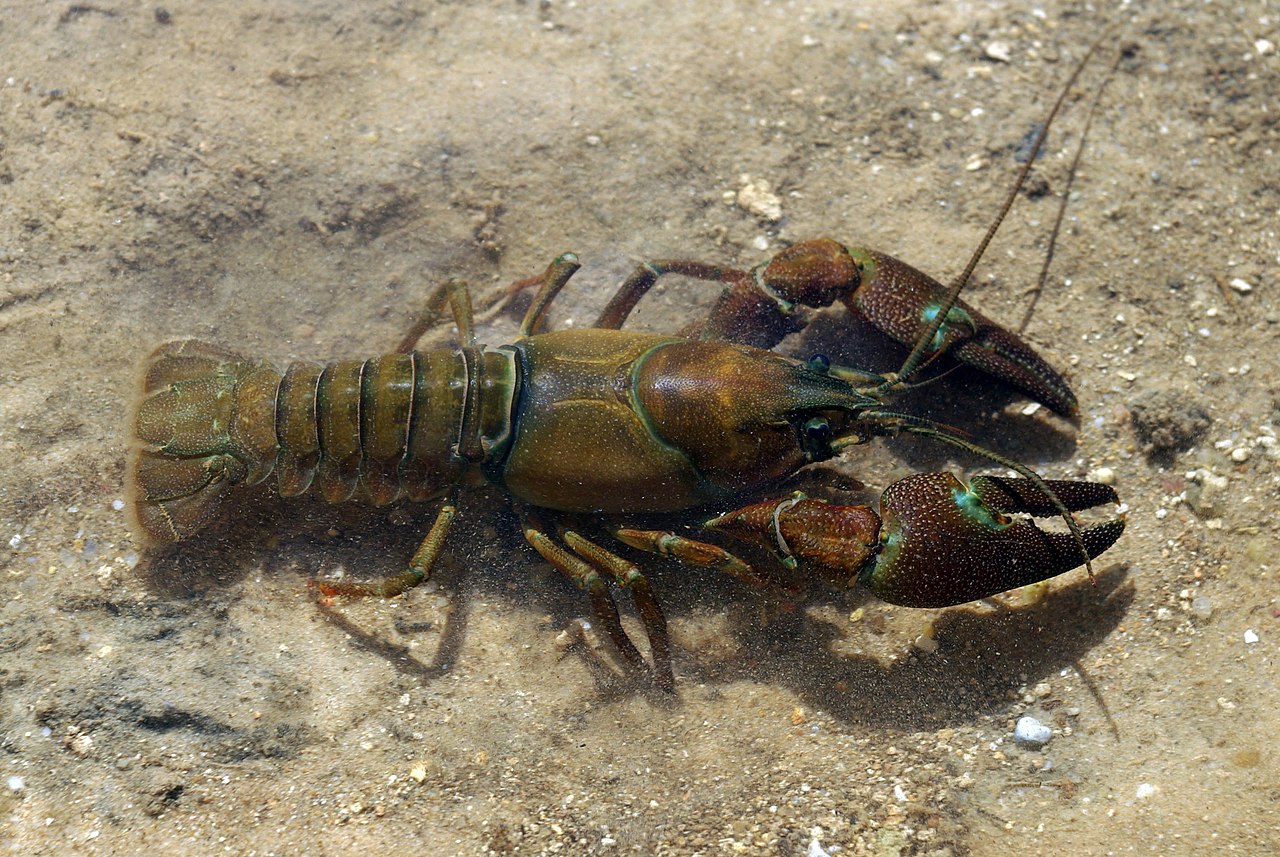
The signal crayfish is a robust freshwater crayfish native to western North America. It visually resembles the European noble crayfish but grows faster, is more aggressive, and reaches sexual maturity earlier. In Europe, it is considered one of the most problematic invasive species because it carries the crayfish plague, to which it is largely immune, leading to the local extinction of native crayfish populations.
Details
Identification
Characteristic white to light blue patch at the claw hinge ('signal'), smooth carapace, red undersides of claws.
Social behavior
Solitary and territorial; aggressively defends burrows against conspecifics and other species.
Diet
Omnivorous generalist: Feeds on detritus, aquatic plants, insect larvae, mollusks, and small fish.
Hunting strategy
Combination of active scavenging, grazing on periphyton, and ambush hunting of small invertebrates.
Spawning substrate
The eggs are carried by the female on the pleopods under the abdomen.
Overwintering
Reduced activity in deeper, frost-free water zones or deep burrows in the bank area.
Ecology
Ecological role
Decomposer and predator; can destroy macrophyte beds and reduce invertebrate biodiversity through high grazing pressure.
Natural predators
Eel, pike, perch, otter, muskrat, grey heron, and raccoon.
Competitor species
Noble crayfish (Astacus astacus), stone crayfish (Austropotamobius torrentium), Galician crayfish.
Ecosystem service
Removal of organic material and carrion, though ecologically mostly harmful due to invasive nature.
Threats
Hardly threatened in Europe; populations are controlled through targeted removal and management measures.
Scientific profile
Profile
Distinguishing features
The most important feature is the whitish to turquoise patch at the claw hinge ('signal'). The upper side of the claws is smooth without rows of tubercles. Unlike the spiny-cheek crayfish, it lacks spines on the cheeks or behind the cervical groove. The rostrum sides are nearly parallel, ending in a sharp apical spine.
Diet
Detritus, aquatic plants, algae, macrozoobenthos (insect larvae, mollusks), amphibian spawn, and small fish.
Reproduction
Sexual reproduction; mating occurs in autumn (September to November). The female carries the fertilized eggs (attached to pleopods) over the winter until they hatch in May or June.
Role in food web
Keystone species with strong ecosystem impact; reduces invertebrate density through predation and competes with native crayfish species.
Protection & threats
Main threats
No threat in Europe; it is itself a threat to biodiversity. In its native range (North America): habitat loss and water pollution.
Conservation measures
In Europe: Management measures to prevent spread, fishing bans for native species, stocking bans for signal crayfish, construction of crayfish barriers.