Jointed Rush
Juncus articulatus
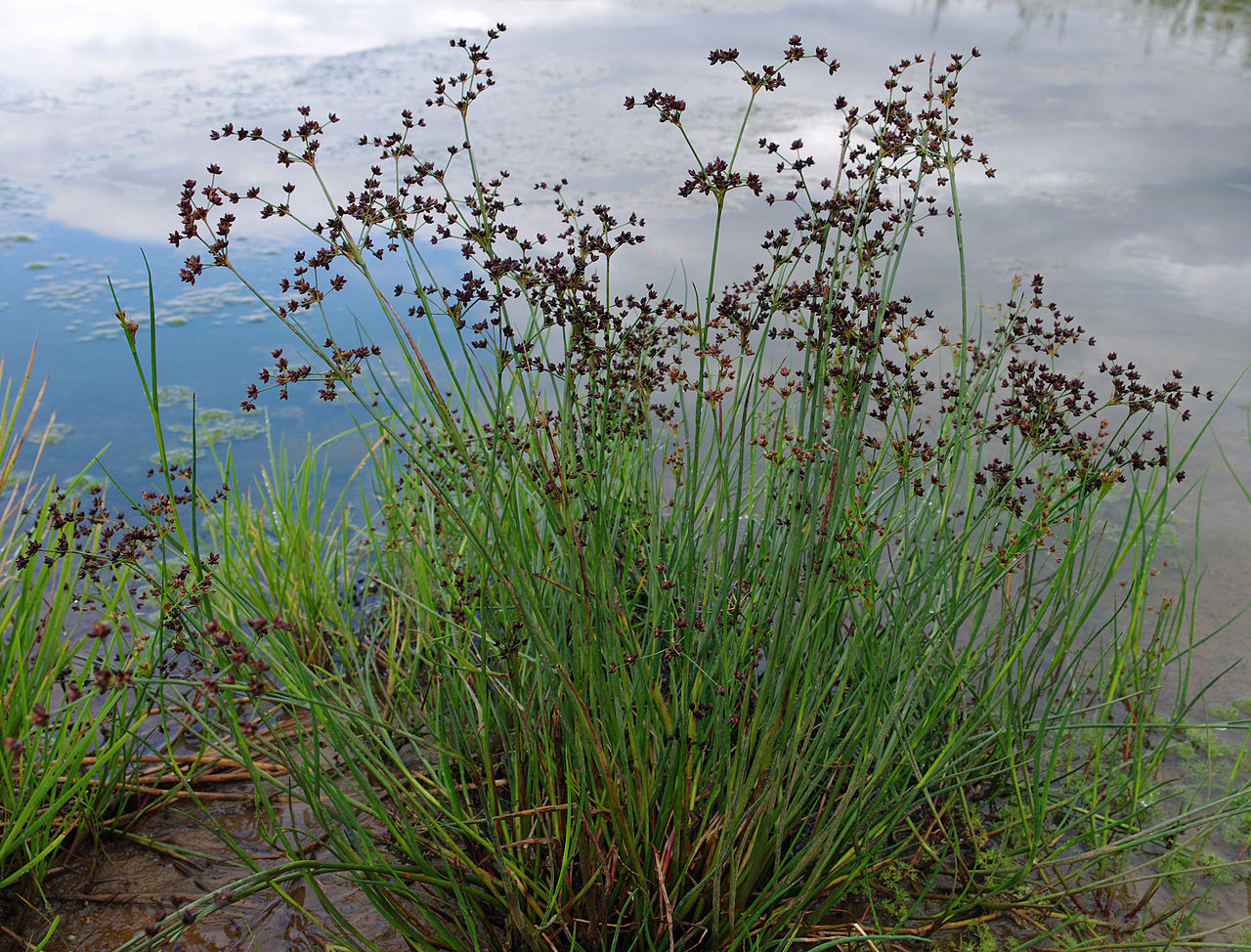
The jointed rush is a perennial herbaceous plant reaching heights of 10 to 80 centimeters. It is characterized by hollow stems and leaves with distinct internal transverse septa, which are clearly felt when sliding fingers along them. The plant develops creeping rhizomes and bears a loose, branched inflorescence with numerous dark brown to blackish flower clusters.
Details
Oxygen production
Minor oxygen production via photosynthesis in emergent parts; aeration of the sediment via aerenchyma.
Habitat function
Provides cover for amphibians and invertebrates; stems are used for egg-laying by dragonflies.
Nutrient uptake
Absorbs nitrogen and phosphorus from the sediment and water, thus acting against eutrophication.
Food source for
Seeds for waterfowl; stems for specialized weevils and true bugs.
Human use
Occasionally used in pond restoration; historically used sporadically for weaving.
Ecology
Ecological role
Pioneer species in open, wet areas; contributes to the structural diversity of riparian habitats.
Competitor species
Other rush species (e.g., Juncus effusus) or sedges in moist habitats.
Ecosystem service
Soil stabilization in erosion zones of banks and contribution to water purification.
Threats
Drainage of wet meadows, intensive grazing, and destruction of riparian buffer strips.
Scientific profile
Profile
Reproduction
Generative via numerous small seeds and vegetative via creeping, branched rhizomes; occasionally vivipary (bulbils in the inflorescence) occurs.
Protection & threats
Main threats
Threatened by the drainage of wetlands, intensive agricultural use of riparian buffer strips, and heavy eutrophication.