Fire Salamander
Salamandra salamandra
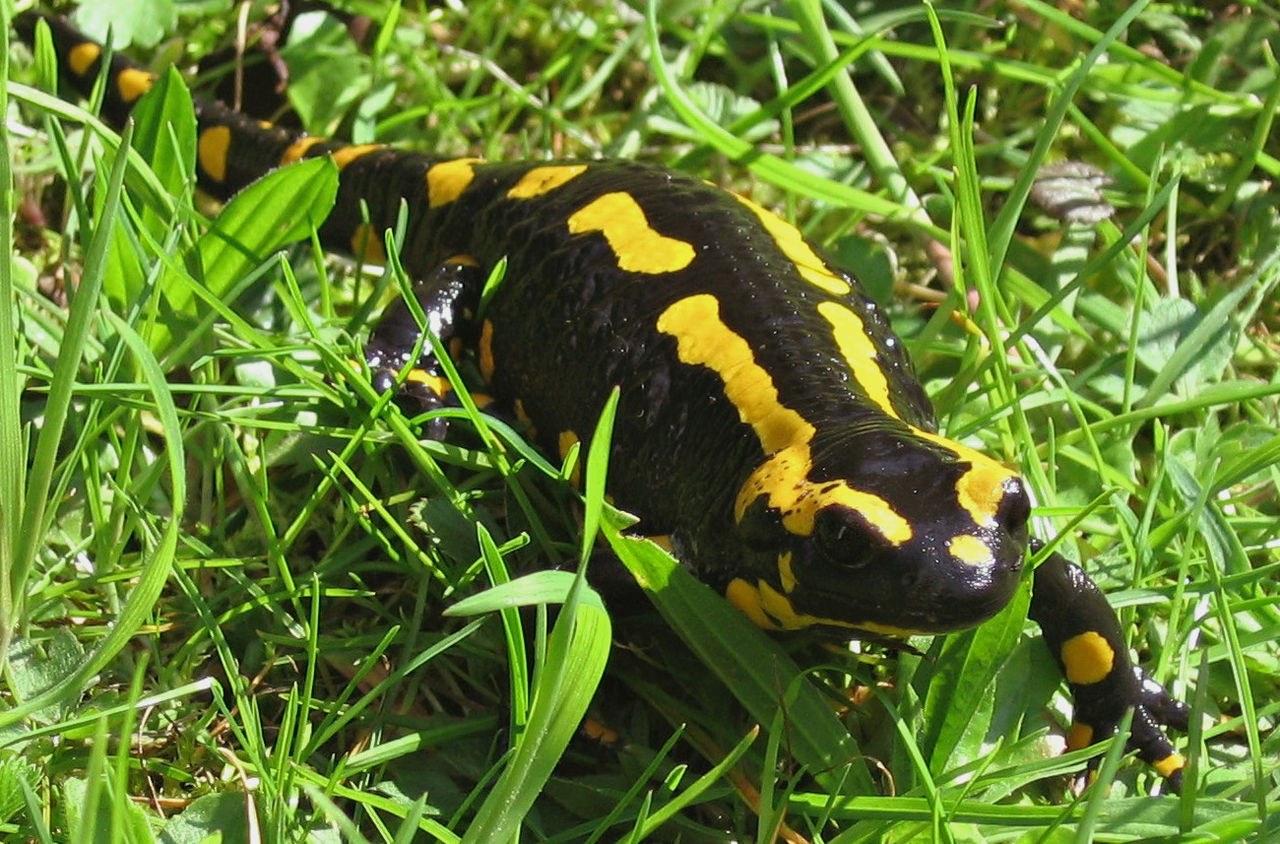
The fire salamander is a distinctive European amphibian characterized by its smooth, deep black skin with yellow or orange spots or stripes. It primarily inhabits moist deciduous forests near cool, oxygen-rich headwater streams where the larvae are deposited. The species is predominantly terrestrial and nocturnal, frequently emerging from its hiding spots during humid weather or rainfall. It is well-known for its prominent poison glands behind the eyes, which produce secretions to deter potential predators.
Details
Identification
Black and yellow warning coloration, two rows of poison glands (parotoids) behind the eyes, glandular pore rows on the back.
Social behavior
Largely solitary lifestyle, but occasionally uses communal wintering quarters.
Diet
Carnivorous; feeds on earthworms, slugs, insects, spiders, and occasionally smaller amphibians.
Hunting strategy
Ambush predator or active searching at night; prey is captured with the jaws or the tongue.
Spawning substrate
Cool, oxygen-rich running waters, often in low-current bays or pools.
Overwintering
Overwintering in frost-free crevices, burrows, caves, or old mine tunnels.
Ecology
Ecological role
Important predator of forest floor invertebrates; larvae regulate aquatic insect populations.
Natural predators
Adults have few natural predators (protected by samandarin); larvae are eaten by fish and aquatic insects.
Competitor species
Other amphibian species such as the alpine salamander or alpine newt in overlapping habitats.
Ecosystem service
Regulation of pests and contribution to biodiversity in forest ecosystems.
Threats
Habitat fragmentation, roadkill, and the invasive fungal disease Bsal ('salamander eater').
Scientific profile
Profile
Distinguishing features
Large, robust body; broad head with distinct parotoid glands; vertical pupils; characteristic yellow-and-black pattern; larvae possess light spots at the base of their limbs.
Role in food web
Secondary consumer; as a larva, an important predator in lotic ecosystems; as an adult, a regulator of insect and slug populations.
Protection & threats
Main threats
Spread of the fungus Batrachochytrium salamandrivorans (Bsal - 'salamander eater'), habitat fragmentation, road mortality, forestry conversion of deciduous to coniferous forests.
Population trend
Regionally strongly declining in Germany, especially in areas with Bsal occurrence (Eifel, Ruhr area, Bavaria); globally stable to decreasing.
Conservation measures
Protection and restoration of spring brooks; maintenance of structurally rich deciduous mixed forests; construction of amphibian protection systems on roads; monitoring and hygiene protocols for Bsal prevention.