Marsh Woundwort
Stachys palustris
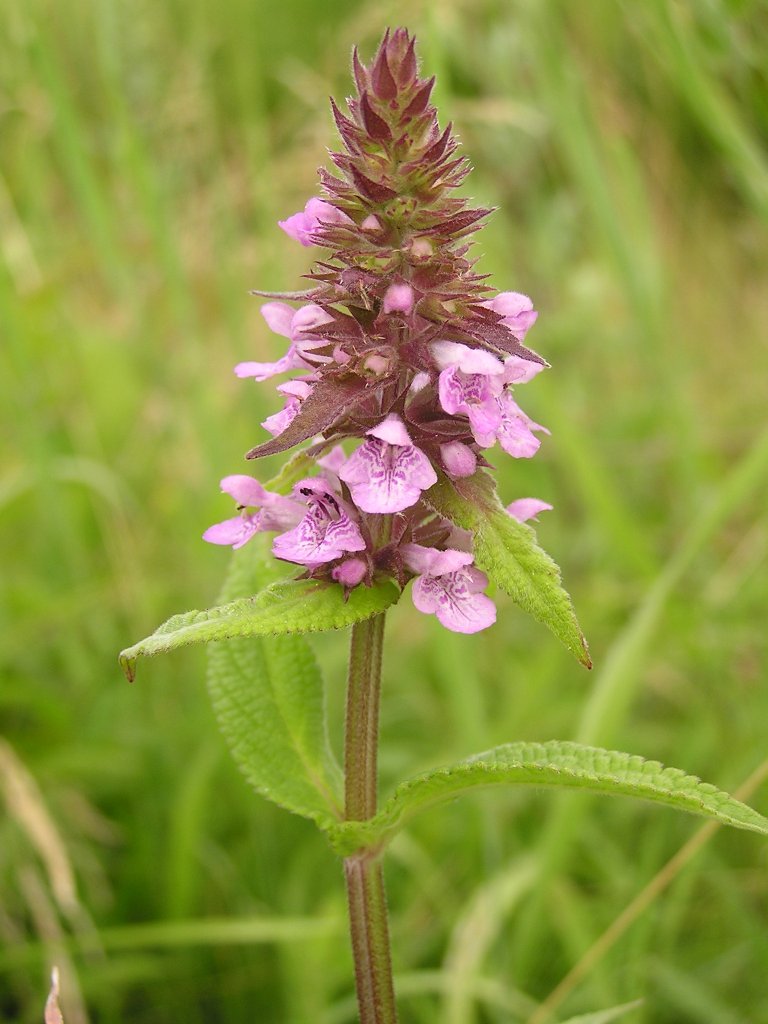
Marsh Woundwort is a perennial herbaceous plant in the mint family (Lamiaceae), growing up to 100 cm tall. It features a characteristic square, hollow stem and opposite, lanceolate leaves with serrated margins. The purplish-pink flowers bloom from June to September, arranged in terminal spikes of pseudowhorls. The plant spreads vigorously via underground creeping rhizomes, which often develop tuberous thickenings at their tips.
Details
Oxygen production
Minor importance compared to submerged plants; primarily contributes to soil aeration through root respiration.
Habitat function
Provides cover for amphibians and small invertebrates; serves as a larval habitat for specialized insects.
Nutrient uptake
High capacity for nitrogen and phosphate uptake from water-saturated soils.
Food source for
Important forage plant for bumblebees, bees (e.g., Anthidium species), and hoverflies.
Human use
Formerly used as a medicinal plant for wound healing; the starch-rich rhizome tubers are edible when cooked.
Ecology
Ecological role
Pioneer plant in riparian habitats, contributes to soil stabilization and serves as an important nectar source.
Natural predators
Various insect larvae and beetles (e.g., leaf beetles) that feed on the foliage.
Competitor species
Other tall herbs of wet meadows such as Meadowsweet (Filipendula ulmaria) or Reed Canary Grass (Phalaris arundinacea).
Ecosystem service
Shoreline stabilization, reduction of nutrient inputs into water bodies (phytoremediation), provision of food for pollinators.
Threats
Drainage of wetlands, intensive agriculture, shoreline engineering, and loss of natural floodplains.
Scientific profile
Profile
Reproduction
Generative via seeds (nutlets) and vegetative via underground runners (rhizomes), which are tuberously thickened at the ends for dispersal and storage.
Protection & threats
Main threats
Drainage of wetlands, intensive agricultural use of riparian buffer zones, and the straightening of watercourses.